
Click on the page to continue. (Under Maintenance)
ㅤ




Index
Info
Role
FAQ
Technical
Art
Game
Development & Design
Software
Development & Design
Discord
Development & Design
Security
Engineering
Music
Production


Info
"An organized whole that is
more than the sum of its parts."

- X
- GitHub
- ArtStation
- DeviantArt
- Sketchfab
- Spotify
- Apple Music
- YouTube Music
- SoundCloud
- Amazon Music
- Bandcamp
- Medium
- Goodreads
- Substack
- Steam
- Ko-fi
- Letterboxd
Discord:
ms.dysphoria⬔⬕⬔
This place serves as my personal space, portfolio, and my central hub containing my contact details as well as links to all of my verifiable accounts. If you're directed here from a platform or by an account not explicitly referenced on this page, tread lightly: treat it as suspicious and refrain from sharing personal details or making payments.
I go by the name Vespera and by the alias Ms. Dysphoria.I am a polymath/artist: driven by a thirst for knowledge, I've spent decades exploring numerous artistic and technical disciplines, alongside intellectual subjects spanning philosophy, psychology, philology, politics, biology, history, mythology and theology.
My primary medium is music: I've been composing and producing songs since 2010. Over the past decades, I've authored many pieces, and just as many as a ghostwriter. I play the viola alongside the piano, guitar, and various other instruments, while also being intrigued by rare ones like the viola d'amore, double violin, and hurdy gurdy. Beyond music, I am interested in audio engineering, and I aspire to become a luthier.
My academic field is literature: I have studied both English and American literature, but left college without completing any degree due to sociopolitical circumstances. I've abandoned the prospect of becoming a teacher, but I'm still involved in literature as an independent writer writing grotesque institutional satire on the issues of today.My intellectual focus is politics, philosophy & ethics: I've been particularly invested in these subjects, eventually founding and now spearheading Absolute Liberation, a philosophical and political movement committed to the liberation of all sentient life.
My profession is game development & design: I've been involved in it since 2020, primarily as a generalist and a technical project manager in the indie game industry. Offering my services as a freelancer, I've contributed to many projects on contract, stepping into key roles and handling nearly every aspect of development and design. My long-term aspirations in the game industry include building a reliable team, founding a game studio, and ultimately authoring The Twilight Zone of video games.
As of 2026, I am learning industrial automation engineering and IT/OT convergence, with the aim of expanding from software engineering into hardware and electronics.
Ms. Dysphoria
23/08/2026
Music (WIP)
Eternal Return
Atmospheric Metal / Experimental
“Eternal Return” draws inspiration from the idea of eternal recurrence: the notion that time is an infinite loop in which the same moments repeat over and over, exactly as before, for all eternity.In this experimental compilation, I intend to resurrect many old movies and radio broadcasts as pieces designed to loop forever.I am open for suggestions on public domain movies and broadcast for the next pieces.
XII
Neo-classical / Dark New Age
The Good & The Bad
Progressive Rock
"XII" is a compilation of piano tracks I composed between 2013 and 2025.
Will be added in time.
Graphene
Metal / Post-Metal
Singles
Avant-garde Metal / Pagan Metal


Professional
| Info |
|---|
| For clients, collaborators, employers, and teams. |
| Which games have you worked on? |
|---|
| My experience includes freelance contributions to game projects on contract, as well as works on projects with content-sensitive nature that I prefer not to include in my professional background. For that, there are no titles I could reference. |
| Over the past years, I have mainly worked on MMO games. My responsibilities involved character customization systems, 2D/3D design (textures, overlays, hairstyles, wearables, blendshapes, editor, interface), asset management & integration, QA, optimization, and also improving pipelines and programming new features to enhance gameplay and customization. |
| Can you work on other game engines (e.g. Unreal)? |
|---|
| My specialty is Unity Engine and I have been developing and modding games built on that engine since 2020. I have no experience in other game engines, but I am open for studying and learning after a long-term employment agreement. |
| What are your thoughts on using ready frameworks and assets? |
|---|
| I favor self-reliance when building systems to maintain full control and grow accustomed to it so that I can navigate and build more easily, while selectively using pre-made scripts where it improves efficiency without compromising integrity. |
| What is your academic field? |
|---|
| I have studied English Literature, both British and American, though I didn’t complete a degree. Literature holds a special place for me. All other fields I have expertise in are the result of self-teaching, without any formal academic background. |
| How can you make time for everything? |
|---|
| If I am expected to work in every single field on my own, that would naturally take time. After all, I am still a single person and can handle one subject at a time, and for that reason, it would be more time efficient when I am given a team to work with so I can manage everything more effectively through task assignment, collaboration, and filling in vacant positions. |
| What is one thing you value the most? |
|---|
| In systems, order is what ensures function, and chaos, when left unchecked, can cascade and become difficult to contain. Accordingly, this is one of the things I value the most: building systems in a way they can withstand and contain entropy. This approach allows the system to remain accessible and manageable for the team throughout the development phase. |
| Another thing I value highly is automation: building pipelines and workflows to reduce manual labor and dependence on developers and other intermediaries, rendering the ecosystem fully accessible and open to designers and modders alike. |
| What are your long-term aspirations? |
|---|
| I aspire to author "The Twilight Zone" of video games and narrate many chilling and thought-provoking stories. My goal is recruiting reliable team members and kickstarting the game projects I've been working on, aiming to gain public and financial support in order to lay out the foundation for the studio I aim to establish. If everything goes according to plan, I intend to release many titles, as I am never short of stories to tell. |
| What are your expectations from your collaborators? |
|---|
| First and foremost, I'd expect people to understand that game development and design can be highly challenging due to its complex and multifaceted nature. It can be demanding: the development phase, release, and beyond. There is always the possibility of failing to achieve the expected results in terms of marketing and profit to continue operations, and on top of that, significant platform fees and operational costs heavily reduce margins, making it even harder for studios to survive. This is the production reality. The field requires passion and dedication, as it does not always reward hard work. Those who enter the field for wealth or fame often wind up disappointed, as game platforms are graveyards in disguise. We are currently operating in an ever-advancing, hypercompetitive, and oversaturated corrosive environment. |
| Those who read this and still remain determined under that pressure meet the initial expectation. |
| The first expectation is the ability to realistically assess the situation: being grounded and aware of the difficulties ahead. Secondly, commitment and composure, the capability to see things through under stress and distress: the resolve to pull things together is integral in overcoming the obstacles that will inevitably arise. Thirdly, a willingness to learn, the drive for self-improvement. I liken this field to a river: if one remains idle for long, the current will swiftly pull them backwards. Lastly, being considerate and organized. When working as a team, there needs to be coordinated effort and consideration for everyone's part in the team: this approach makes everyone's work easier, leading to greater stability and momentum. |
| These traits are essential to operating effectively as a team and seeing a project through to completion. |
| Regarding people who utilize AI in their workflow, they may refer to Artificial Intelligence. |

Business
| Info |
|---|
| For commissions, payment, warranty, refunds, and delivery expectations. |
| What is your policy when conducting business? |
|---|
| My policy revolves around reliability and customer satisfaction. I am a perfectionist and I take pride in the work I create. Personally, I wouldn't hand over a project that I didn't feel proud of. My principle is working with diligence and delivering pleasant results that leave people asking for more: that is how I make a living. For that, I don't mind going the extra mile. |
| How do you guarantee reliability and delivery quality? |
|---|
| I place great value on my clienteles, as it is essential for ensuring the continuity of commissions and long-term working relationships as a freelancer. Delivering poor-quality work or leaving my clients dissatisfied would harm my business by costing me potential long-term clients. Ultimately, anything that harms my clients harms me and anything that benefits them benefits me in the long run. I believe mutual self-interest is resonating for everyone and sufficient to establish trust. |
| "When my client wins, I win. When my client loses, I lose my client." |
| How much do you charge for your services? |
|---|
| For small-scale indie and passion projects, I typically charge around €250-€500 per week of work. |
| For ambitious and funded projects, pricing is usually around €600-€1000 per week. |
| For full-time corporate work, my salary expectations start from €5000. |
| Ultimately, pricing is situational and depends on the job and mutual agreement. |
| Do you use LinkedIn or recruiting platforms? |
|---|
| I am not present on LinkedIn or other professional recruiting platforms. |
| Do you work through Fiverr or freelance platforms? |
|---|
| I do not use Fiverr due to its unacceptably high service fees. I prefer to conduct business in person and in the most financially effective way: without any middlemen, unnecessary charges, or cuts imposed on me and my customers. |
| Do you issue invoices or payment confirmations? |
|---|
| I operate as an independent freelancer. While I am not running a registered company currently, I can provide written agreements and payment confirmations when required for accounting purposes. |
| Can transactions be handled through escrow? |
|---|
| For transactions and delivery, I am open to making use of escrow services when requested or deemed required. |
| Do you offer a warranty? |
|---|
| I offer a warranty and provide free of charge troubleshooting and repair if any issue arises related to the delivered work. |
| Do you offer refunds? |
|---|
| I offer refunds if I fail to deliver the agreed-upon results or fail to uphold the terms of the warranty. |
| Do you use AI? |
|---|
| I do not utilize AI for works of art I deliver unless requested. For programming-related works, I may utilize responsibly. |
| For more information, see Artificial Intelligence. |
| Which payment methods do you accept? |
|---|
| I accept direct bank transfer through Wise and TransferGo as well as transfers through Paypal. |
| Are there any fees included? |
|---|
| I do not charge VAT or additional fees. |

Personal
| Info |
|---|
| For those personally interested. |
| How can you do all these? |
|---|
| I've had a long time to teach myself across all these fields in the last decades. |
| I started making music at the age of 10. I'd compose with a virtual piano I had on my computer. I took up drawing around those ages, I'd draw and spend time on Photoshop, altering photos and creating multimedia art. As for 3D design, I was 14 when I first obtained a copy of 3DSMax through their student program and took up 3D modelling and texturing. I got into game development and design as a modder when I was 23. Over time, I have cultivated expertise to develop from scratch. |
| This has been what I've been doing my entire life. Instead of setting a goal to master a specific branch and focusing on it exclusively, I decided to explore everything. This approach has its upsides and downsides. In the end, I've sacrificed total mastery in a single field for versatility and become a generalist. |
| As the adage goes: "Jack of all trades, master of none, though oftentimes better than a master of one". |
| How can you keep everything in mind? |
|---|
| It is expectedly difficult when attention spans across too many fields. One can forget about APIs and functions needed to program for instance. I personally have trouble writing code without checking any documents or my notes on functions. It is the same with applications: it can take some time to re-adapt. I do not keep everything in mind, rather, I keep notes. |
| What are your hobbies? |
|---|
| Besides the fields already mentioned, I like cooking and inventing new vegan recipes. While my specialty in 3D modeling is hairstyles, I also practice hairstyling and dyeing in real life as a hobbyist. I am an aspiring tattoo artist. I enjoy playing my viocello, creating new techniques, and composing songs. In addition, I enjoy dressing up and cosplay, to name some. |
| Who are your favorite writers? |
|---|
| There are several writers whose works and themes I like. I'd name Thomas Bernhard, Emil Cioran, Michel Foucault, Giorgio Agamben, Franz Kafka, Jean Baudrillard, as well as Adam Fawer, Jean-Christophe Grangé, and Ahmet Umit. |
| What do you listen to? |
|---|
| I believe that what people listen to reflects who they are. My favorite genres are indie rock and spoken word, as I have a strong appreciation for poetry, as well as avant-garde and post-metal. Bands I would name include mewithoutYou, Wolf Parade, La Dispute, and Hotel Books. |
| What are your favourite games? |
|---|
| Since it is my profession, I believe a longer answer with impressions would be better fitting than simply listing away. |
| I'm a big fan of Silent Hill. My favorites in the franchise are The Room and Homecoming despite their unpopularity. The new titles, Silent Hill 2 Remake and Silent Hill F, are nice, though I find the direction somewhat troubling: the franchise seems to be moving toward shooter and hack & slash. I believe the franchise is most successful when it's survival horror and when horrors can't be blasted away with a shotgun, which The Room handles effectively through its undying ghosts. |
| Alice: Madness Returns is one of the best games, I'd say: art-wise and story-wise, it is captivating and quite underrated. The design is praiseworthy, especially the art style for cinematics, which is quite unique and fitting for the atmosphere, as well as the otherworldly and captivating level design. |
| Deadly Premonition is another underrated game. It has a nice atmosphere, interesting characters, and a mysterious plot: it makes one tolerate the poor gameplay mechanics and all the bugs, hopelessly. |
| I like Dead Space, including the movies and the books of the franchise. The atmosphere of the games in the franchise is flawless: it successfully reflects the title through its portrayal of desolation and despair. |
| Besides these, I like the Warhammer 40K universe and I enjoy reading its massive lore. I would name Dawn of War - Dark Crusade & Soulstorm and Space Marine as successful titles. This universe has so much potential but I don't think it is yet anywhere near realizing that. THQ had an ambitious project: Dark Millennium Online, but unfortunately it was scrapped. I believe that game as an MMO had the potential to outcompete World of Warcraft given the chance. |
| Speaking of World of Warcraft, it is another universe I like. I started playing the MMO back in 2008 when it had the Wrath of the Lich King expansion. For this title, I'd say it's been moving further away from realizing its potential ever since then. Cataclysm and Mists of Pandaria were nice expansions, but after these, it seemingly lost its integrity and direction. It has strong lore; it needs solid titles. Some of the books I like are: Day of the Dragon, Lord of the Clans, and The Last Guardian. |
| My other favorites: The Evil Within, Amnesia, Bioshock, Far Cry, Fallout, Persona, The Room (Puzzle Game), Mass Effect, as well as most of the titles by Telltale Games. |
| Why? |
|---|
| I was too late for treats. |

Artificial Intelligence
| Info |
|---|
| For clients, collaborators, and teams concerned with AI policy, authorship, proof of work, and operational safety. |
| Do you use AI? |
|---|
| When conducting business, that entirely depends on whether my customers or employers want me to make use of AI as a tool to enhance productivity. I believe the secret use of generative AI would be unethical, as it can subject customers and employers to legal and communal inconveniences. Therefore in a business setting, I act on the directives given to me and deliver the results in a way the requesting parties expect. I am also able to provide proof of work to clear suspicion for PR. |
| On personal projects, I sometimes make use of AI but I try not to rely on it for the sake of self-growth and to be in control. When developing a framework, I find it essential to be self-reliant and build in a mindful way to be able to keep in control and aware of the state. I mainly utilize it for tedious tasks like creating large dictionaries and searching for API functions. |
| What are your thoughts on collaborators utilizing AI? |
|---|
| There are two ways to utilize AI and only one can be considered operationally responsible and safe. |
| As a developer who has worked in multiple teams and inspected code written by many developers, I can identify patterns commonly found in AI output without any meaningful human authorship. These outputs often include redundant checks and fallbacks, needless variables, runtime assignment depending on complex object hierarchies or naming conventions, hard coding interface design instead of utilizing the Unity Editor, god classes, and a lack of consideration for modularity, scalability, optimization, coding standards and collaboration. This introduces operational risk. Besides its function, code serves as a tool of communication between developers, and accordingly code needs to be understandable and accessible: this principle is integral when working in a team, and the absence of such consideration can actively hinder organization and collaborative efforts. This way of utilizing AI can be regarded as irresponsible use, but this is not about AI generation; rather, it is about not proofreading and not taking initiative to produce proper contributions to the project and the team. |
| As a designer, I am strict about the use of generative AI. When utilized irresponsibly, it can jeopardize the integrity of the project and public relations for the studio and potentially cause copyright problems, becoming an unpredictable liability. Generative AI is in a gray area and it involves risks, as anything produced without sufficient human authorship cannot be copyrighted, rendering it unsafe to depend on. These days, proof of work can be regarded as de facto proof of ownership: possessing project files or footage involving time-lapses would be invaluable in proving authenticity and mitigating risks. Ultimately, I find it crucial to be strict about such use of generative AI and produce in a manner that is operationally safe. |
| For employment or the purposes of teaming up, I find it crucial to evaluate the base knowledge and skills of the applicant or volunteer to see how well they can fare without depending on the use of any AI agent or tool to determine the baseline experience of the individual on the matter. How viable would this person be in an environment where AI is not accessible or permitted? Does the individual possess sufficient capability for decision-making without dependence on any AI agent? Determining the baseline experience without any dependency on AI would be invaluable in building trust and confidence. |
| In the end, it is about architectural integrity and operational safety. Any AI use is acceptable only if it respects these and does not degrade system quality, authorship clarity, or possibly introduce legal liabilities or communal incidents. For this reason, use of AI must be supervised and made compliant with applicable legislation and standard operating procedures. |
| What is your personal stance on generative AI? |
|---|
| I have mixed opinions when it comes to AI. For starters, it has devalued many fields by oversupplying and oversaturating the scene with content. It is brutally effective and time-efficient, and as a result, it places too many expectations and too much pressure on real artists, who have no way of competing with that. As these trends continue, I believe it will become increasingly difficult to make a living in these fields professionally, causing many to lose their hard-earned jobs, passions and ambitions to machines. An AI to code, an AI to paint, an AI to animate, an AI to voiceover: all is becoming automated. |
| I liken this to how technological advancements, like the invention of the printing press, made the art of handwriting and scribing obsolete. If this trend cannot be stopped, I believe those who have put in the effort and contributed to the world through art have the right to make use of AI if it will ensure their survival. In my eyes, they are the ones who have earned that right. I prefer working with people and their creativity: if I can ever afford to, I will always personally choose to do so. |
| Ultimately, I am against generative AI in its current state and view it as a machine of plagiarism destroying the meaning of art. If Gen AI could be removed altogether, I would fully support that course of action. However, that seems unlikely to happen. For that reason, I believe, as artists, we have the right to make use of that, if this is what it takes to compete and survive in this dystopian setting, as it is our work that was taken away, compressed into a unified whole, changed shapes, created anew, and now it is circulating. This can be regarded as compensation for the damage and for the lifelong efforts. |

End Game

Role
| Info |
|---|
| I possess expertise across technical and creative fields, capable of stepping into any required roles and leading teams. Below you can find more about my roles, some of the tasks I have undertaken, as well as the tools I have experience in. |
Technical Project Manager
| Info |
|---|
| This section involves information regarding my professional background alongside my management philosophy. |
| Background |
|---|
| In my past experience, I managed production and teams (≅ 10 members) on active MMO projects, with around 5,000 DAU and 500 CCU. I directed the art department, programming and community management. In terms of the art department, I inspected production, made contributions, issued guidelines and templates, built communication platforms, developed pipelines, guided and integrated members into the workflow. As for programming, I served as an advisor and contributed to planning and direction as well as codebase development. In terms of public facing operations I handled infrastructure, prepared written and visual materials for public communications, and ensured proper staff conduct and communication for the support team by inspecting logs and tickets. Additionally, I was involved in client and server security and stability. |
| Consequently, I have attained expertise in technical project management over the years, through management as well as direct involvement in development and design within resource-constrained and understaffed live-service environments. |
| Philosophy |
|---|
| My understanding of project management goes beyond managing staff: it is technical and hands-on. |
| I approach management as a service-oriented role. When I lack knowledge, I learn. When guidance is needed, I mentor. When obstacles arise, I assist. This soft hierarchy creates continuity and encourages growth within the team as a whole. |
| In my books, a manager must be a server for everyone: a bridge that brings individuals and elements together into a unified whole, and an overseer who ensures that each part functions cooperatively and coherently within the system. |
| I am familiar with practices and tools of the trade across many sectors. I use the same terminology and speak the same languages. I am aware of how much time and effort it takes to carry out tasks, whether it is 3D modeling, programming, designing, rigging, weight-painting, or composing. I believe that effective management demands at least a fundamental understanding of what each team member does and to what degree they can do it. Without possessing such knowledge, it becomes unrealistic to set viable expectations or make well-informed decisions. And this is what makes my approach to project management fundamentally different: I am not managing from outside the disciplines, but from within them. Ultimately, the individuals in the industry, regardless of their diverse professions, are my fellow professionals. |
Technical Management: Scope & Tasks
| Info |
|---|
| My management is adaptive: it encompasses project, direction, team, pipelines, production, and public-facing operations. In the absence of reliable leads or directors, I assume a greater position to maintain stability, coordination, and continuity. Below are some of the tasks I've handled as a technical project manager while directing and managing projects and teams. |
| Asset Management |
|---|
| Managing AssetBundles and carrying out inspections to ensure file organization, asset quality and optimization. In MMO environments, I managed nearly ten thousand AssetBundles containing textures, meshes, animations, and sounds, using tools such as AssetStudioGUI for bundle inspection, Bulk Rename Utility for managing naming conventions, Audacity for automating audio processing and bulk optimization, DevX for lost asset recovery and bundle modifications, and UABE for extraction and bulk decompression of AssetBundles missing source files or processed by DevX for load-time optimization. |
| Asset Quality Assurance |
|---|
| Inspecting assets and conducting quality assurance. For 3D assets, I ensured that the polygon counts stayed within the designated limits, topology and weight painting were suitable for animation, customization components including item masks, gradient color maps, and blendshapes functioned correctly, and UI icons complied with the overall art direction. As for 2D assets, I ensured that textures had no visible artifacts, transparency was correctly handled, sprite sheets were prepared properly for animation playback, and 2D designs remained visually consistent within the project environment. |
| Making adjustments in texturing, weight painting, modeling, topology, mesh elements, and blendshapes, while applying optimization through polygon reduction and setting up LODs when submitted assets did not meet production standards. |
| Asset Pipelines |
|---|
| Developing new pipelines and workflows to streamline testing and integration for the staff and the modding community. As an example, I developed an automated AssetBundle loading system based on directories (e.g., Female/Wears/Topwear, Male/Hair), alongside naming conventions such as prefixes and suffixes to define custom behaviors (e.g. hair blendshapes for hats, load-order indexing), effectively removing developer dependence and allowing designers to work independently. I converted a 2D core bundle roughly 2 GB in size and containing about 3000 assets into as many separate AssetBundles, integrated them into the directory-based loading system, and introduced direct image loading without needing bundles for testing purposes. This allowed smaller updates, improved memory performance, and easier integration for designers. Similarly, I streamlined the 3D asset loading system for character customization: AssetBundles required a main texture, additional maps depending on the item type (item mask for clothes, color map for hairstyles), and a mesh with LODs set. Icons were kept separately, and this method, coupled with the directory-based loading system, automatically populated editors with icons and instantiated Prefabs for wearables and hairstyles at runtime without any developer involvement. |
| Asset Integration |
|---|
| Integrating produced assets by creating AssetBundles, making codebase adjustments when necessary, organizing assets into update packs, coordinating beta tests, writing logs and preparing visuals for announcements, and updating the FTP. |
| Design Templates |
|---|
| Creating 2D and 3D design templates for official staff and volunteer modders. As an example, I created a hat and hairstyle template with measurement tools indicating a 3D target area hats had to occupy and hair meshes, through blendshapes, needed to morph into: this was to prevent clipping visual artifacts and to ensure official designers and modders produced mutually compatible assets. Design templates I prepare typically include sample assets, UV maps, base models, textures, guidelines and playtesting instructions to keep design and modding involvement organized, independent and accessible. |
| Design Guidelines |
|---|
| Writing 2D/3D design guidelines to ensure that staff and the modding community produced artistically consistent, high-quality, and optimized assets. For example, I issued polygon limits and LOD standards by asset category as requirements for approval, allowing only designs that match the criteria to be added to the game in order to maintain project stability. In my guidelines, I include step-by-step tutorials on design and playtesting, together with common errors and solutions. |
| Community Standards |
|---|
| Ensuring proper conduct and communication within community and among staff through guidelines and enforcement. I've generally operated on Discord and managed communities on that platform. Examples include preparing guidelines, setting up bots for support tickets, system logs, and auto-moderation, and building infrastructure and tools for support and moderation teams. Extending into client-side and server-side, I developed administrative commands and webhook-based logging systems. Using RegEx for profanity detection, I created a system that sent user messages and IDs through Discord Webhook and displayed them as embeds in designated moderation channels while pinging the responsible staff. |
Unity Developer - Generalist - Technical Artist
| Generalism |
|---|
| My specialty as a generalist is that I can comfortably own systems across backend and frontend. I can initiate, structure, and carry projects solo while recognizing that scale and efficiency are best achieved with a team. I contribute to projects through identifying gaps, assuming required roles, stabilizing development, and ensuring continuity across the system. |
| Systems Architecture |
|---|
| From a programming perspective, I design and implement core logic, custom solutions, supporting tools and pipelines to improve efficiency for the team. I ensure the codebase remains organized, optimized, maintainable, and accessible. |
| Unity Development & Design |
|---|
| Within the Unity environment, I develop modular and extensible frameworks. I rely on structured architectures, Prefabs and ScriptableObjects to enable user-friendly workflow alongside configurable MonoBehaviours supported by tools such as Odin Inspector, organized folders, and instructions to refine the development and design experience across the team. |
| Interface Development & Design |
|---|
| I approach interface with both functionality and adaptability in mind. I develop responsive interfaces that support a wide range of aspect ratios while relying on coroutines and custom animation systems to maintain flexibility and consistency. I also create procedurally generated interfaces (e.g., character editor, world editor) through utilizing Prefabs and layouts. |
| Music Production & Audio Engineering |
|---|
| As a composer/music producer, I produce soundtracks and design sound effects. Within the Unity environment, I manage LUFS, arrange AudioMixers, utilize FX components, and create custom Monobehaviours to enhance auditory experience. Additionally, I can manage high numbers of assets through setting up macros on Audacity: bulk processing, refining, and converting to optimized formats; streamlining workflows and reducing production time for refinement and optimization. |
| 2D Design |
|---|
| When it comes to 2D and visuals, I have shifted my focus to art direction and asset management. I maintain consistency in art style, make adjustments, and integrate assets. I ensure scenes are visually coherent and appealing. I also deal with GUI, and when needed, I create artworks and GUI elements, design communication tools (e.g. Discord), embeds, banners, icons, and such. On the animation side, I am able to handle basic rigging and puppet animation for 2D and video editing. |
| 3D Design |
|---|
| As for 3D design, I create and prepare Unity game-ready assets, including hairstyles, wearables, props, and blendshapes, working both as an editor and a designer. I handle tasks such as porting and adjusting meshes, refining weight painting, creating blendshapes (e.g. face/body morphs, hat compatibility for hair), 3D asset optimization, designing and setting up shaders and materials (e.g. textures, overlays, shader adjustments, item masks, color maps for hairstyles...). I ensure that 3D assets are in good quality, without visual artifacts, properly optimized, consistent, and flexible for user customization. |
| Security Engineering |
|---|
| From a security standpoint, I implement practical solutions to mitigate asset theft, exploitation, and service disruptions. This includes codebase and asset protection, encryption, obfuscation, and custom DDoS gating systems fitting for needs. |
| Server Administration |
|---|
| As an administrator, I manage server infrastructure, including databases, file transfer systems, and create applications (updaters/file verifying launchers), while ensuring safety, accessibility, synchronization across the technical ecosystem. |
| Community Management |
|---|
| I contribute to public-facing operations, such as Discord infrastructure and design, tribunals, and moderation to ensure staff representation and public communications remain structured, functional, reputable, and aligned with the project. |
Skill Stack
Creative & Technical Domains
Application Stack
Software & Tools
Game Development & Design
| Info |
|---|
| Below you can find out about my background and some of my projects. |
Background
I've been involved in game development and design since 2020, working primarily with Unity and C#. Throughout my career, I've most commonly worked on 3D MMORPGs and 2D side-scroller games while offering my services as a freelance generalist. My responsibilities included providing guidance, coordinating teams and efforts, and filling in gaps to maintain development progress.I learned game development and design in live indie MMORPGs, under pressure and within constraints, solving real production issues, watching systems break, and iterating until they worked. This experience shaped the way I approach game development, with a focus on long-term system stability and maintainability.
I am familiar with designing and developing original frameworks to streamline game development, relying on ScriptableObjects and editor tools such as Odin Inspector for project scalability and inspector accessibility. Working solo and across multiple fields taught me the value of building in a way that is cooperative and future-facing: developing pipelines to minimize workload across fields while ensuring proper organization and structure for more effective and time-efficient development for game projects.Below are some of my solo works alongside their descriptions. Due to the content-sensitive nature of most of my works, more extensive demonstrations can be provided only privately.
Hybrid 2D/3D Rendering Pipeline
In this example, I set out to create a hybrid rendering system by combining 2D URP with 3D elements. I utilized Sprite Renderers within a perspective 3D environment to achieve layered parallax effect while reserving full 3D rendering for the character model.I integrated MeshRenderers into the 2D URP lighting system through a script calculating light to maintain visual coherence, bridging systems that are not natively compatible in order to expand flexibility and reduce reliance on 2D animation.
Dynamic Weather & Environment System
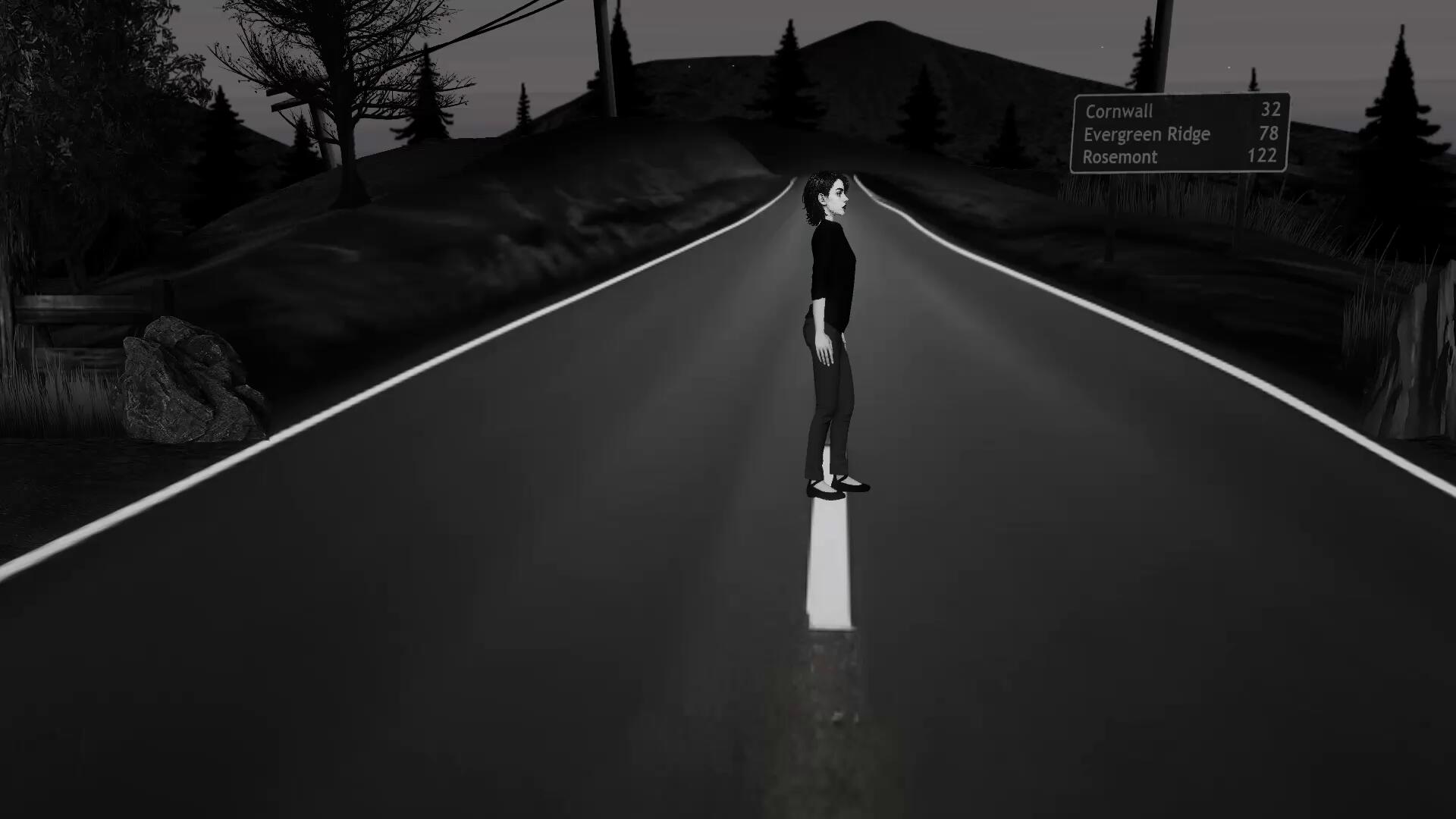
This displays a weather system I created as part of my original framework. The system manages environmental lighting, sky elements, ambient audio, wind direction and intensity, and fog parameters through coordinated transitions. These operations are handled using linear interpolation for seamless blending.Rain dynamically updates the ground wetness parameter, which other modules use to adjust their behavior accordingly to maintain environmental coherence. As an example, the sound module instantiates random splash sound effects, with volume and frequency depending on the wetness parameter.Wind data is propagated to custom shaders via a global wind intensity parameter, enabling shader-driven object movement that remains consistent with the current weather conditions.Environment configurations are stored as Scriptable Objects, allowing profiles to be created by level designers with ease.
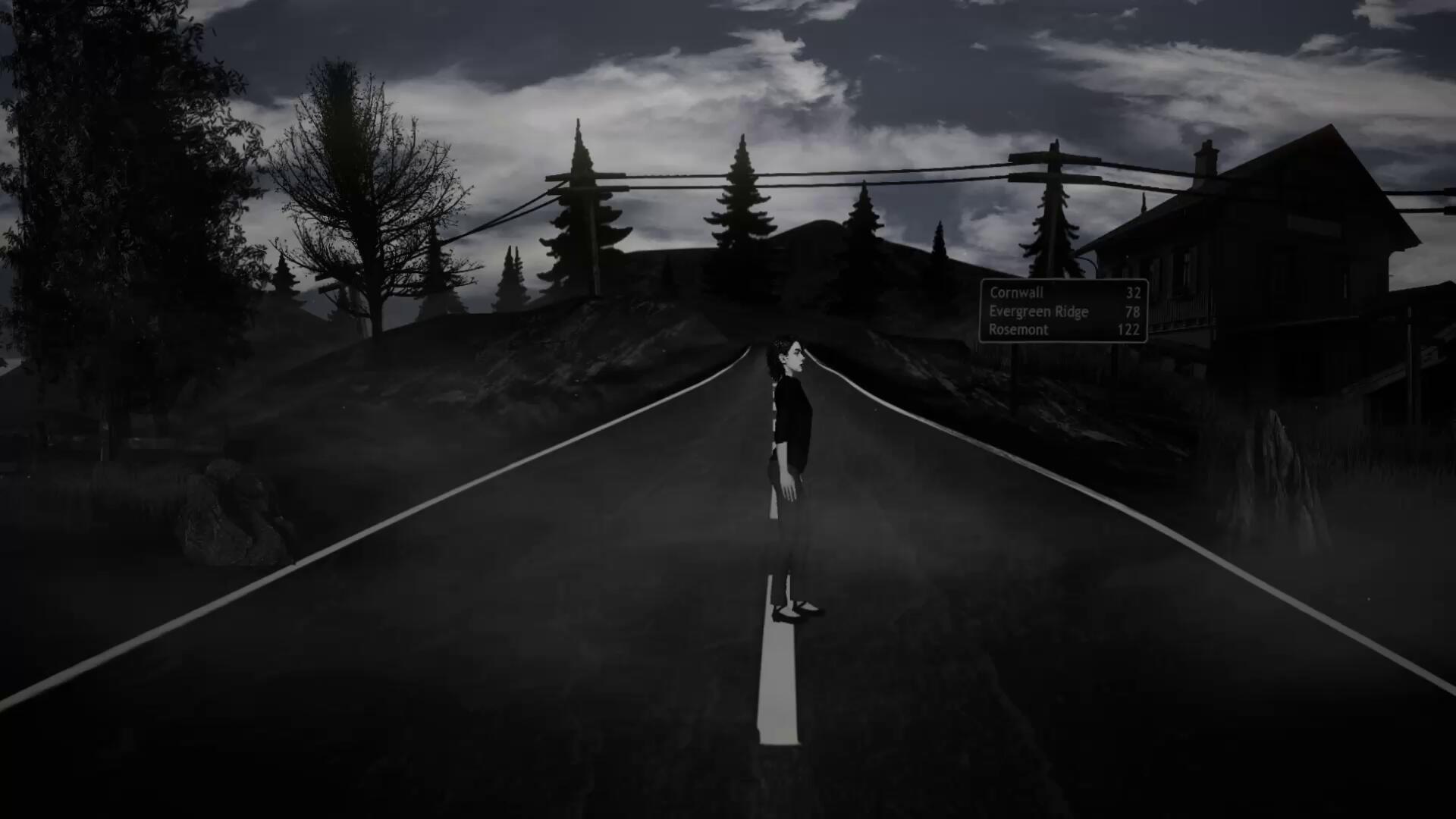
The system contains a post-processing controller that accesses and adjusts camera Volume Profile properties at runtime and enables dynamic control over these parameters, including color grading, bloom, SSR, chromatic aberration, LUT, among others.These visual effects can be tied to environmental conditions, such as gradual change for bloom and screen space reflection intensity during sunrise and sunset to enhance the atmosphere.
3D Hair Physics Integration For 2D URP
In this example, I implemented 3D hair with physics within a 2D URP environment, based on com.unity.demoteam.hair package. I built and groomed an Alembic hairstyle for the character and fine-tuned its simulation parameters to achieve stable real-time performance. The mesh was also integrated into the 2D lighting system through a script calculating the surrounding light.The hair module was integrated with the existing weather framework, propagating wind intensity and directional data to ensure consistency with environmental conditions.
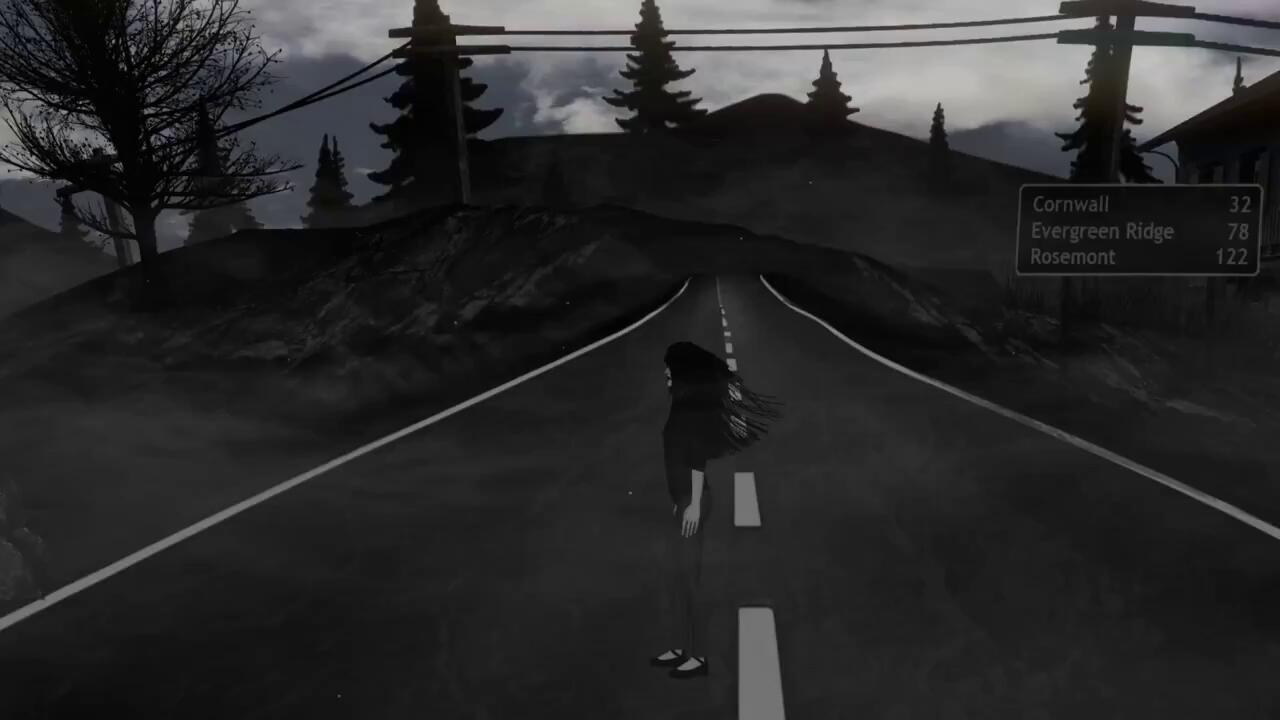
Immersive Notebook System
This example showcases a prototype for an interactive notebook system I designed to replace traditional quest and document trackers in favor of a more immersive experience. I find it effective to reduce reliance on conventional HUD elements and instead convey information through visual and auditory cues within the game environment for better player immersion.
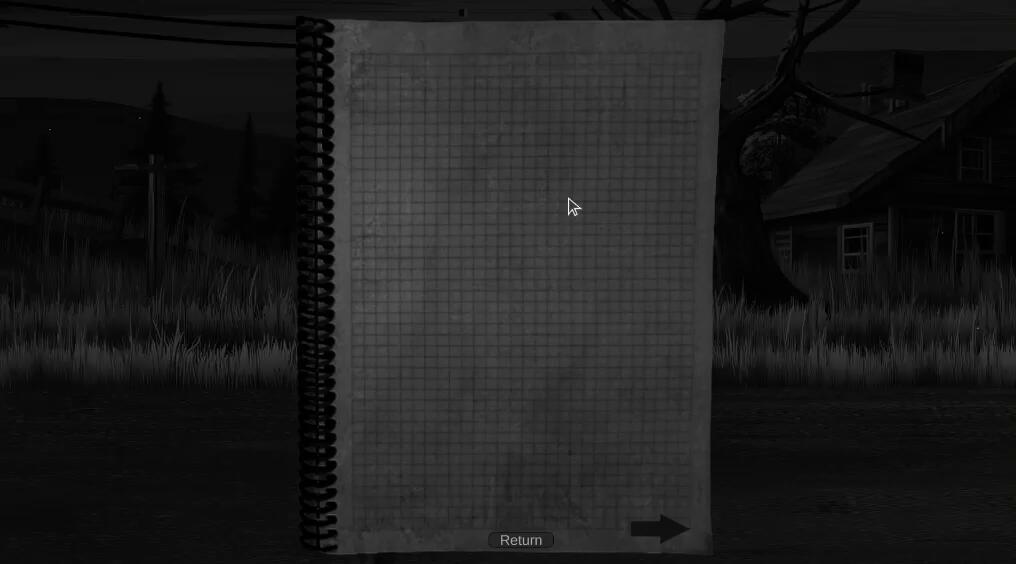
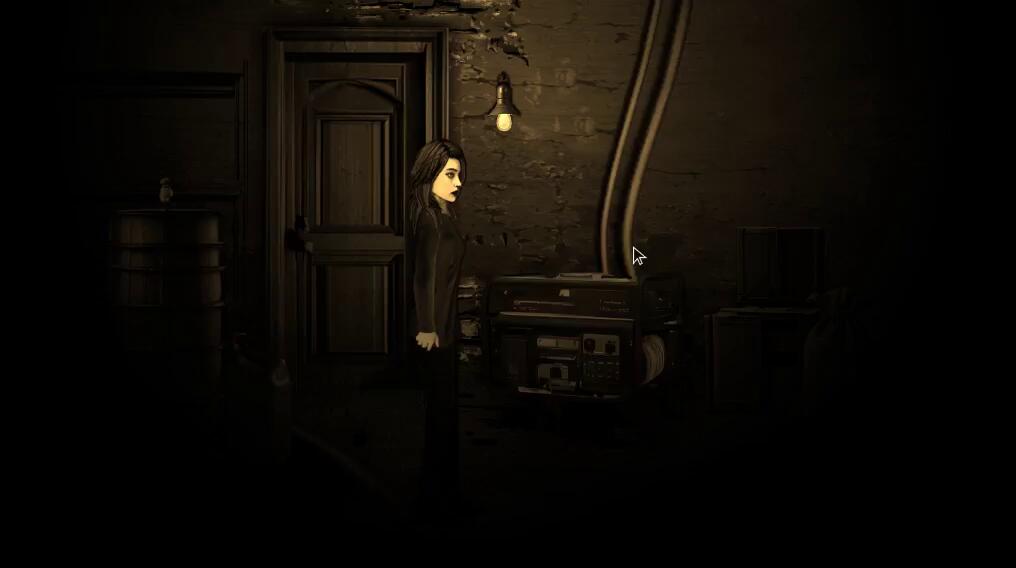
Power & Lighting Control System
This prototype from my early days demonstrates a generator system that manages the light sources and electrical appliances designated in its object array. All state transitions are handled using a coroutine with linear interpolation to create a natural feel, with the object sounds adjusted similarly through pitch shift to imitate voltage changes and gradual blackout.
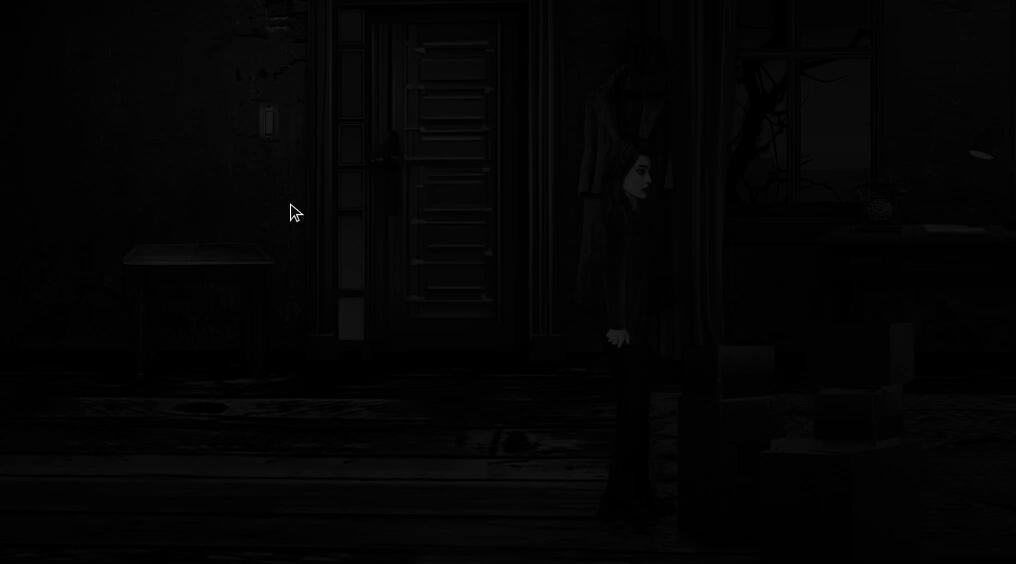
Rotary Phone System
This example showcases a prototype rotary phone I designed and developed in my earlier days as part of my framework. Available phone numbers were stored in an array and mapped to audio clips to be used for puzzles and easter eggs.
3D URP Sprite Rendering Pipeline
While my previous framework relied on the 2D URP lighting system with 3D object integration, in this alternative rendering implementation, I utilize 3D URP lighting for SpriteRenderers within a 3D environment. I created a custom Shader Graph to make Sprites compatible with 3D URP lighting. It automatically generates normal maps using the main texture as a height map. Multiple material presets for sprites can be created and assigned contextually, eliminating the need to create normal maps or configure materials per asset, effectively streamlining level design and saving time, which was the main priority for this system: utilizing SpriteRenderer as a component was more practical than using planar meshes with MeshRenderers due to the simplicity and efficiency of using Sprites.This example also showcases several supporting modules from the framework. The door system integrates volume post-processing effects with teleportation logic to create seamless transitions between areas. The interaction system instantiates buttons into the world and renders the targeted object through a dedicated camera and RenderTexture. A typewriter module handles progressive text generation, while the audio system makes use of AudioMixer with several exposed parameters and filter components (e.g., low-pass, reverb, echo), synchronized with a room module that manages environmental settings.
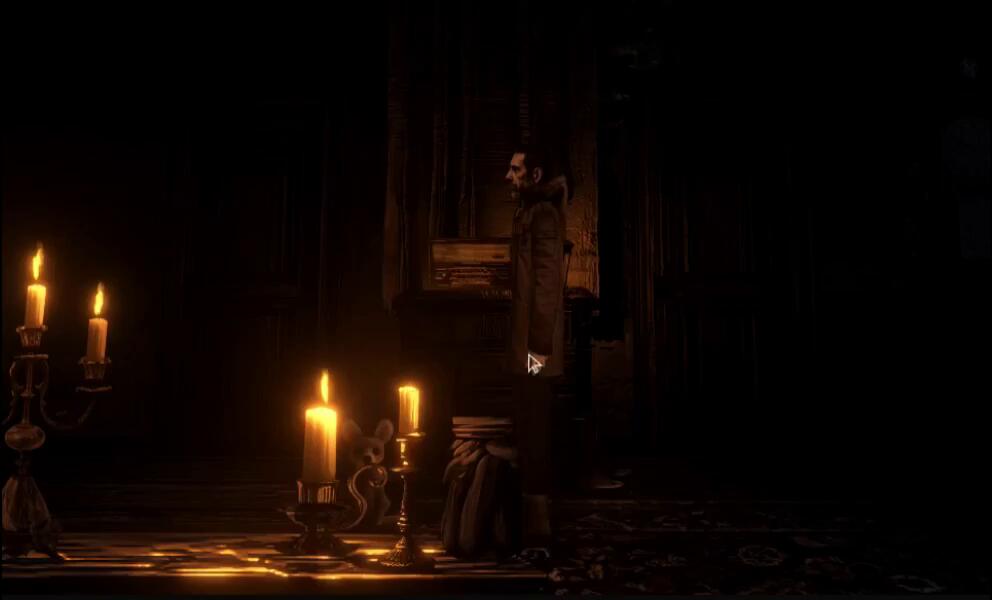
Signal Encoding & Transmission System
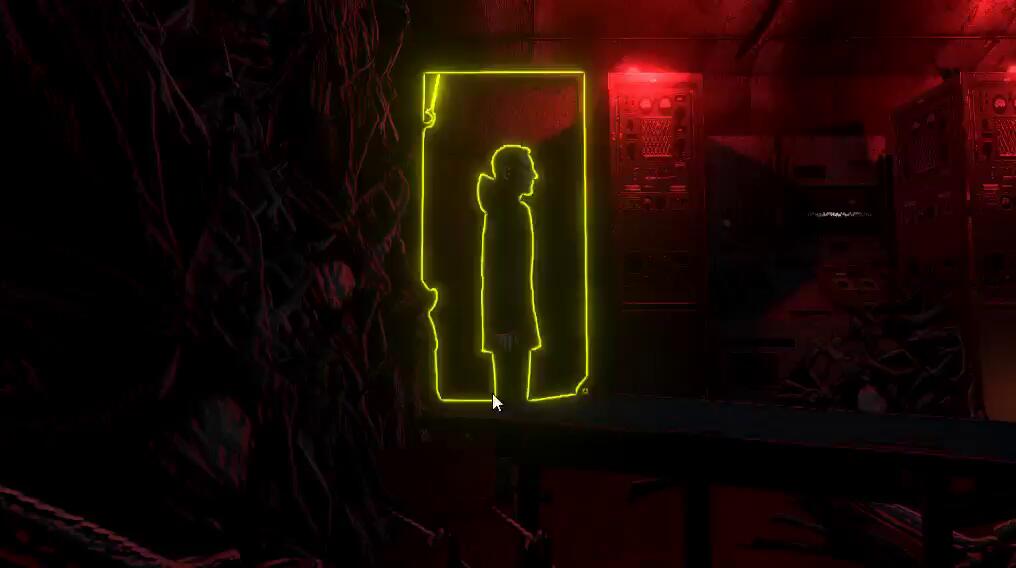
This prototype implements a Morse transmission system using a dictionary-based encoding structure to convert text input into timed signal output. Characters are translated into dots and dashes, with controlled delays between letters and words to replicate authentic Morse transmission fitting for a submarine.Signals are conveyed through synchronized lighting effects and a visual output based on LineRenderer component, while word separations trigger a static noise that serves as a cue to render the system more accessible and enhance the atmosphere.
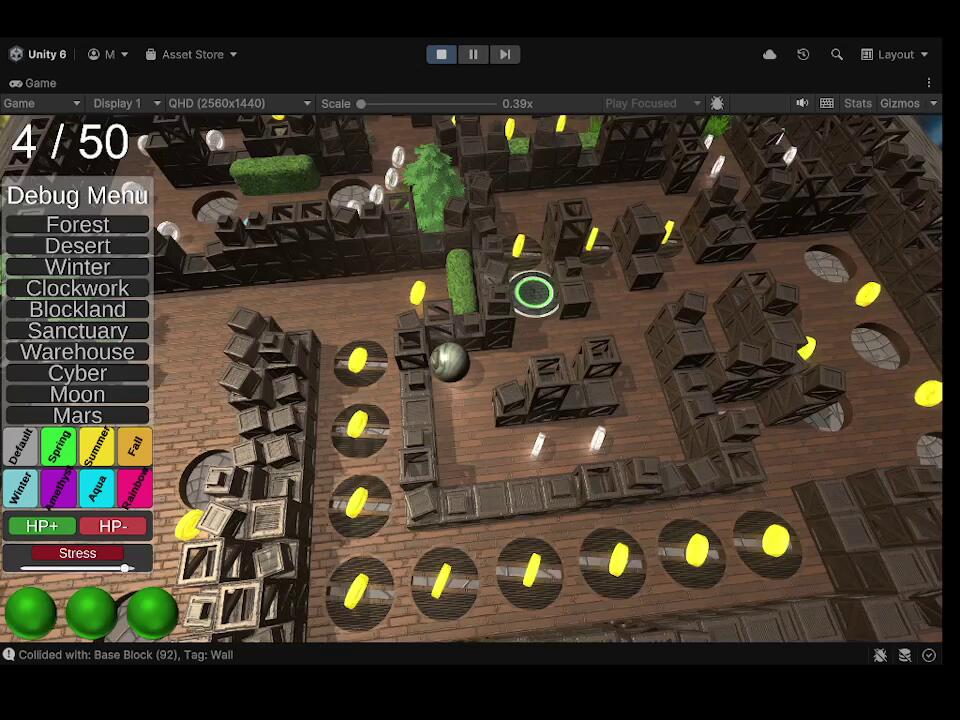
Procedural Labyrinth System
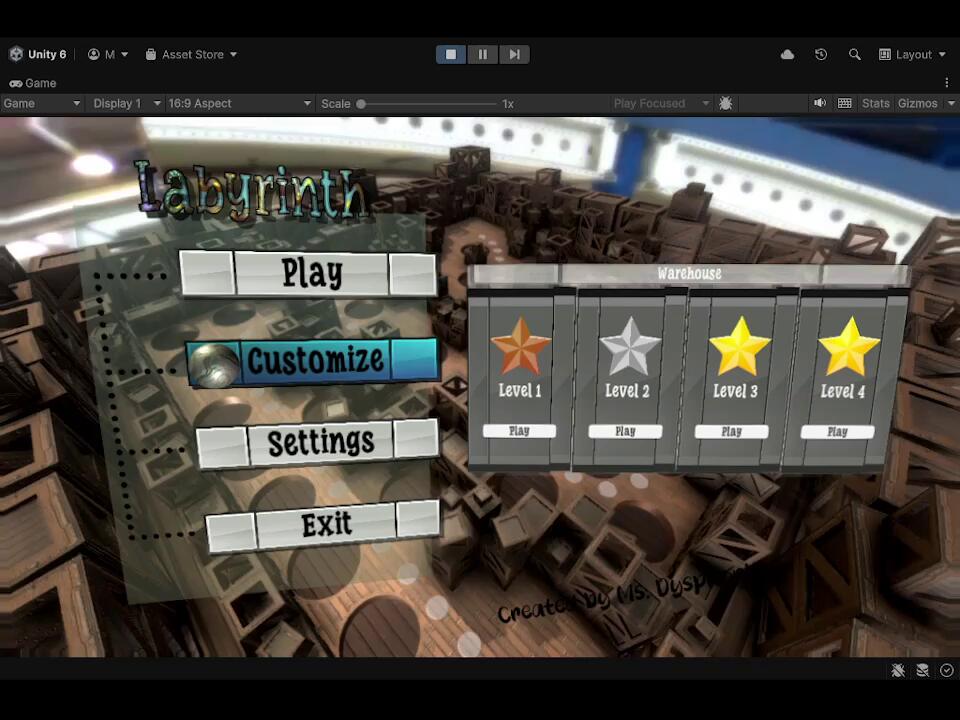
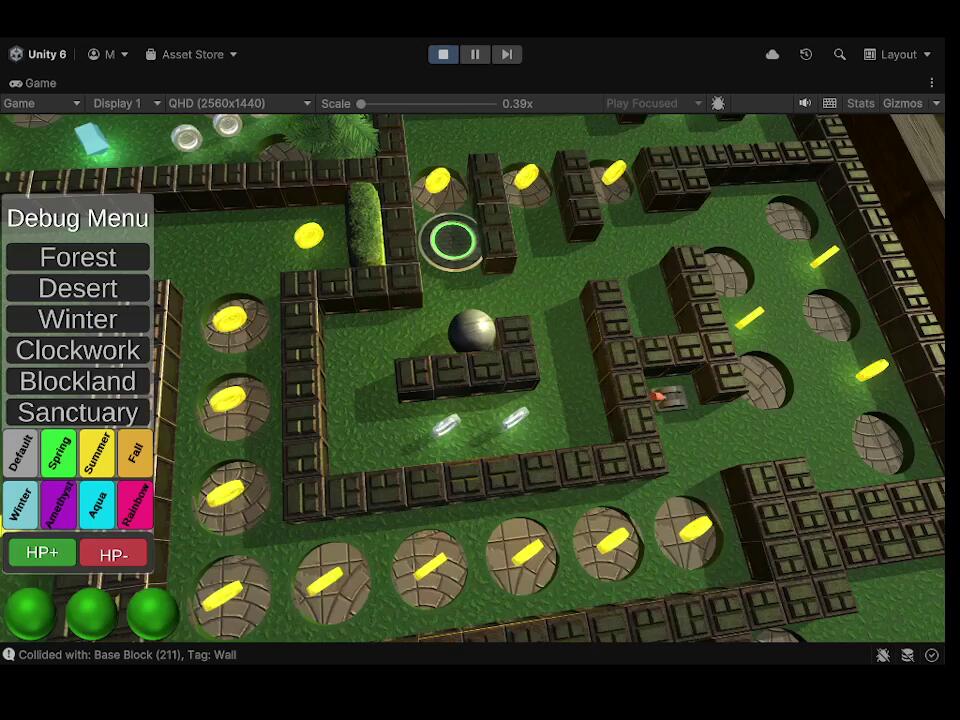
This prototype was inspired by the physical marble game and The Labyrinth Plus!, which was distributed with Microsoft Plus.To replicate the core gameplay logic without heavily relying on complex mesh construction, I studied shaders and made use of Stencil Buffers to render holes on planar surfaces. This allowed holes to be placed directly on flat geometries, simplifying level design significantly. Trigger colliders were placed accordingly to make the ball fall through designated stencils for the logic.I made use of tilemap as a grid system to structure mazes and developed a ScriptableObject-based configuration for levels that replaced blocks and environment objects for maze dynamically. The level system was designed to generate randomized outputs, introducing variation each time a labyrinth was constructed. Mesh variations for blocks were assigned from arrays, with random rotation, and themes and colors applied. Configuration settings also controlled the skybox, background music, ground textures, and labyrinth frame for visual consistency. For ground trails, I deemed it practical and efficient to make use of Sprite Shape, and utilized it to create the trails as ground details.
Networked Interactive Pet System
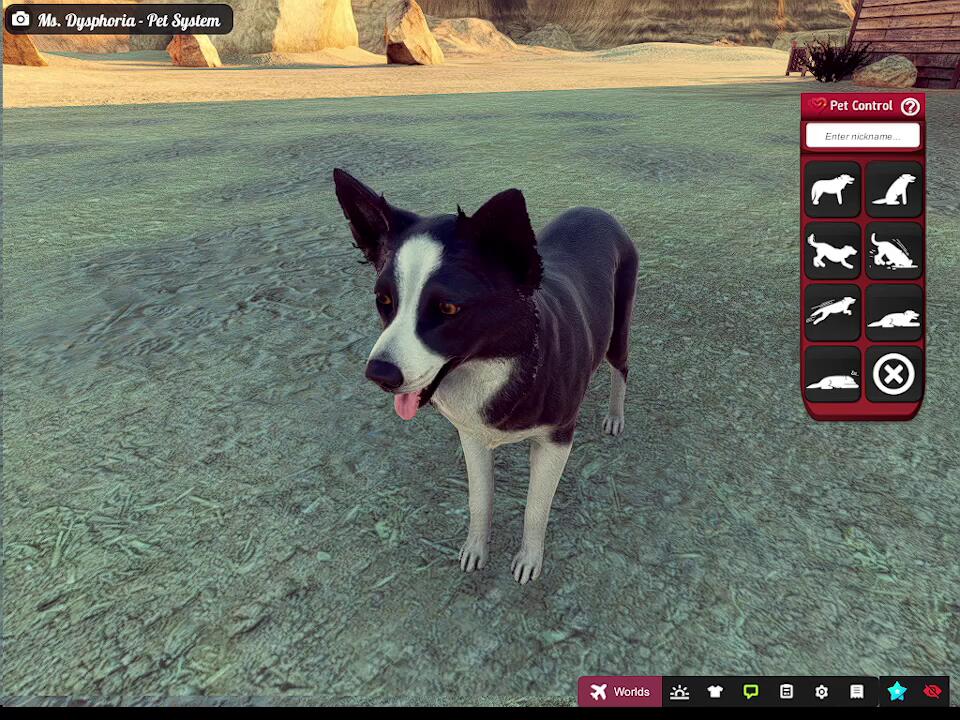
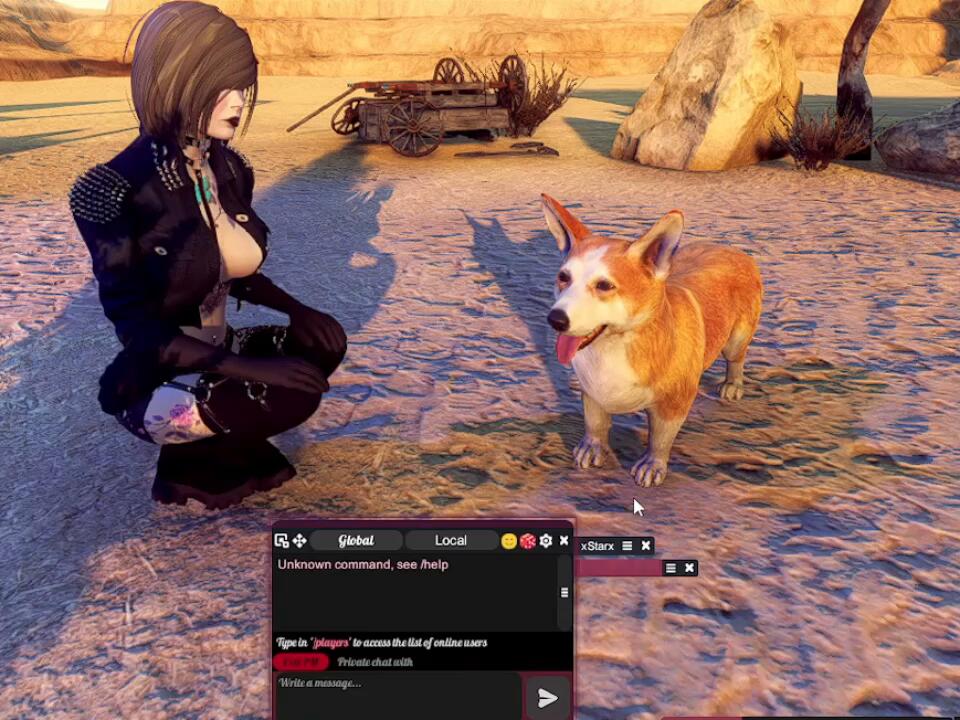
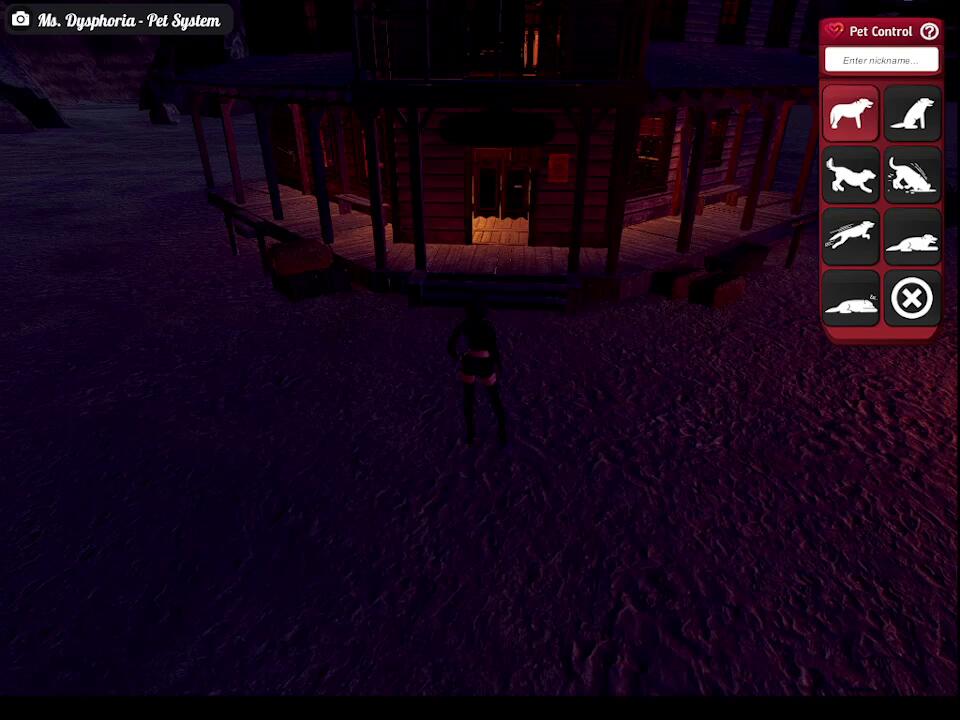
This one demonstrates a pet system I developed for an unofficial community server. Spawning a pet instantiated a control HUD that included an input field for the pet's name, which allowed players to control their pets' behavior through in-game chat by mentioning their name and action. It involved a threshold logic for movement based on distance, changing animation states and speed between walking and running to catch up to the player, alongside manual placement and rotation of pet through specific hotkeys to arrange composition for screenshots.I introduced rate-limiting and also integrated it into the HUD, serving as a cooldown between animations to ensure animation transitions play out properly. This made use of a radial mask.The movements and actions of pets were synchronized across all clients using the platform's native server implementation. The client dispatched a message to the server side, which would be shared with other clients in the same room. This network system allowed features to be implemented using only client-side logic, without the need to make changes on the server.
Networked Animation Layering & Mixing System
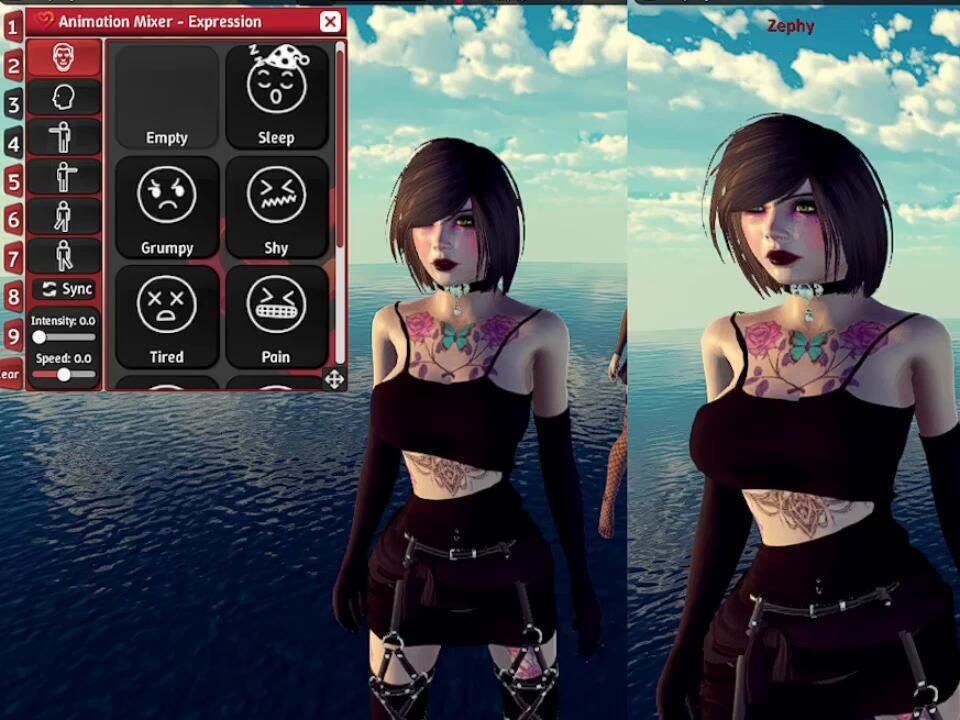
In this example, I developed an animation mixer system for an online social game. The system made use of AnimationState to target specific bones, allowing certain animations to override current animations for selected bones and their hierarchies. Crossfade transitions were used to ensure smooth blending, along with a slider for animation weight to adjust intensity.I developed the system in a way it dynamically instantiated the animation buttons from a client-side list. Button generation was driven by naming conventions: animation identifiers were parsed to generate the labels for display by removing internal markers, replacing underscores/hypen with space, and applying proper capitalization. If the designated AssetBundle contained icons using the same internal animation name, they were automatically added to the HUD. This streamlined the workflow, allowing new animations to be added simply by updating the list and including an icon with the same identifier in the bundle.
Character Editor & Asset Management System
The following work is a character editor and asset system I designed and developed for an MMO game, built around a ScriptableObject-driven editor database, allowing categories, subcategories, and their associated content and settings to be easily defined and instantiated for UI dynamically at runtime. By structuring the system this way, new customization options can be added without modifying the existing code, enabling scalability for content-heavy projects.The editor supports multiple interactive components, such as, selectors, sliders, color pickers, and item pickers, all linked through a consistent ID-based architecture. This allows both indexed and explicitly defined naming, supporting flexible workflows depending on the use case. UI panels are generated automatically based on database entries and can be changed between grid and vertical layout, making the system suitable for both parameter-driven customization and item selection.A key focus of the system is enabling non-programmers to work efficiently, through configurable MonoBehaviours and structured data, designers can manage and extend content, define defaults, and attach additional customization layers, such as color, variations, without engineering involvement.As extra details, I have utilized coroutines for the interface animations, setting anchors and altering transform scale to introduce simple but effective visuals. For the scene lighting, I placed 3 light sources and created arrays including tri-color palette and intensity, and created a coroutine to handle the lighting through a smooth transition, changing the exterior, interior and reflection light simultaneously. As for character randomization, I stored each selector, slider, color selector and item in their respective lists upon instantiation and invoked random values. Directly utilizing editor elements in such a manner removes the need to synchronize the displayed parameters throughout the editor. Besides these, it utilizes ScriptableObject naming for label display, nulling the need for another string variable while also enforcing proper naming in the editor. For the slider behavior which starts filling from the middle, the script disables Unity's default fill bar for cases where slider has a negative minimum value, activates two custom background bars, and drives their image component's fill amount parameter to create fitting visuals.Overall, this prototype demonstrates a scalable and modular approach to character customization and asset management, prioritizing maintainability and workflow efficiency. It reflects my focus on building systems that reduce technical overhead while remaining flexible enough for complex customization requirements in live-service environments.
App Development & Design
| Info |
|---|
| To be added |
Security Engineering
| Info |
|---|
| Below is my background on security and some articles I authored to demonstrate my understanding. |
Background
I began game development in 2020 as a modder for private community servers operating in highly adversarial environments where service disruption and asset theft were persistent threats. These circumstances forced me to adapt and develop pragmatic and often unconventional solutions for these threats to maintain security, stability, and an edge in these environments.What often felt like an endless hackathon pushed me to study obfuscation, reverse engineering, cybersecurity, cryptography, for asset and service protection. I learned that effective security requires understanding of how systems can be disrupted and dismantled by thinking similarly to an attacker, so that counter-measures can be designed around realistic models.
I would not describe myself as a security engineer, nor was security a field I initially set out to pursue. However, working on MMO games meant that security concerns were inseparable from development, as each update carried the potential to introduce new vulnerabilities. As a result, security became embedded in my development process rather than treated as a separate field, and it is in that context discussed here.The articles below reflect my experience as a game developer working in highly competitive and hostile environments, where I often had to assume security responsibilities without any formal training in the field, improvising and learning through hands-on work to deal with a variety of security and stability problems.
Articles
Buying Time: A Practical View of Asset Security
When it comes to asset protection, I have learnt that it is not about creating an impenetrable system, as such a goal is neither realistic nor achievable, but rather about introducing sufficient deterrence to destroy an attacker’s return on investment and motivation.In one case, the game client at hand relied on AES-256 encryption for large quantities of AssetBundles totaling over 15 GB, which proved safe but excessive for the intended purpose. The client depended on constant runtime decryption of AssetBundles and was built on an older framework (Unity 5.5). Because this pipeline relied on memory-based loading, it required encrypted bytes, decrypted bytes, and the reconstructed AssetBundle to coexist in memory during loading, which led to memory surges and prolonged load times.Loading bundles directly from disk rather than memory was the most efficient approach from a performance standpoint, but it would also have made the assets vulnerable to asset theft, which was common within the ecosystem since multiple servers shared the same client, making stolen assets trivial to integrate once decrypted.Given these constraints, I investigated both the technical framework and the practical capabilities of competing servers, and concluded that the cryptographic protection coupled with memory-based loading was imposing a higher cost on the userbase than on attackers. Rather than pursuing encryption, I devised a quick makeshift strategy to protect the assets in a more optimized way.I removed the bundle encryption and instead introduced a low-cost structural incompatibility that relied on visually indistinguishable Unicode identifiers within rig hierarchies, which is something not typically expected. These identifiers were corrected internally at runtime through an obfuscated DLL so that the assets functioned normally within the intended client. The obfuscation had remained unchallenged for over a year, utilizing an obfuscator neither popular nor proven to be compromised.When someone would attempt to integrate the unencrypted bundles directly, the mismatched bone names would cause the rigs to break without any visible error code, preventing direct reuse. Because the spoofed Unicode characters appeared visually identical during inspection, the problem was not obvious and it made diagnostics difficult and time-consuming, as there were many plausible causes for a broken rig. This leveraged attackers' trust in visual inspection, since most asset inspection tools, such as UABE, AssetsStudioGUI, and DevX, and software such as Blender and the Unity Editor do not expose non-ASCII characters, with one of the exceptions being Notepad++ through its ANSI encoding feature, which I found unlikely to be utilized for inspection purposes.Preventing direct asset reuse through this way would generally mean asset extraction and total reconstruction: exporting meshes and textures individually, performing placement after displacement caused by extraction, weight painting and recreating lost blendshapes, and similarly time-consuming tasks, functioning as a way to raise the cost.Additionally, shaders for Unity 5.5.5p2 could not be decompiled using DevX or UABE, which were the primary tools competitors relied on at the time. However, leaving these shaders in unencrypted bundles would have allowed direct bundle integration and reuse through runtime shader assignment for the assets. For this reason, they were kept in a separate encrypted bundle, as custom legacy shaders were rare and highly valuable. This prevented visual fidelity from being replicated outside the intended client and added further deterrence. Together, these measures substantially increased the time, effort, and expertise required to reuse the assets, effectively destroying the attackers’ return on investment within that ecosystem.In the end, this approach involved calculated risk and an asymmetric defense that deliberately targeted human inspection habits, and it proved effective. It did not make the system more secure in an absolute sense, nor was it considered a long-term solution. Rather, I viewed it as targeted, low-cost structural incompatibility that raised attacker cost and time investment enough to function as an effective deterrent, while significantly improving AssetBundle loading performance for the userbase. Removal of encryption coupled with AssetBundle decompression carried out through UABE reduced loading time by approximately 90%. This approach proved valuable in preserving project survivability during its growth phase in such adversarial environments.At times, simple and pragmatic solutions such as these can be sufficient for the task at hand. Security, in this context, is about stalling until a project achieves decisive success and reaches a point where such disruptions no longer matter. This is my view of asset security in such ecosystems: buying time and making use of that time to gain a lasting edge.
Ms. Dysphoria
31.12.2025
Practical DDoS Mitigation for Constrained Systems
The first time I was approached by a self-proclaimed cybersecurity engineer was during an active DDoS attack on a game server I had been contracted to support as a freelance game developer and designer. I received an offer of protection almost immediately after the service disruption began. Combined with the fact that the contractor remained anonymous and unwilling to disclose any verifiable base of operations to establish authenticity, this raised reasonable suspicion that the situation followed one of the oldest tricks in the books: Secretly introducing a problem and then offering a paid solution.Service disruption through DDoS attacks is sometimes employed by individuals without legitimate cybersecurity credentials, who rely on the appearance of authority to engage in extortion in disguise, and at times the motive is to harm competitors in order to gain an edge in the environment. Such service disruptions are commonly utilized, largely because it is easy to execute and requires minimal resources relative to the impact it can produce. In terms of competition, when paired with aggressive advertising, such attacks can be leveraged by competitors as a means of growth by pressuring users into migration, particularly in MMO games where the player base represents the platform’s most valuable asset, effectively functioning as a form of asset theft. Anticipating the motivations of attackers behind such disruptions is essential for implementing proportionate and cost-efficient counter-measures.At the scale most game servers operate, the majority of DDoS incidents are carried out using readily available tools and services by individuals lacking in-depth expertise. These attacks often rely on a single attack vector rather than a coordinated multi-layer strategy, and for this reason, most incidents at this scale do not require complex or expensive enterprise-grade solutions to mitigate effectively.After testing numerous service providers, I have observed that low-tier offerings frequently failed to provide sufficient filtering or effective anti-DDoS protection to ensure server stability. Some mid-tier providers offered more capable defenses, most notably challenge-based systems like traditional CAPTCHA for filtering, which I find quite effective at verifying humanity and mitigating botnet traffic. However, when operating under strict budget constraints, seeking third-party protection can become a costly trial and error.As a result, rather than relying on third-party DDoS mitigation services, I proceeded to design ways of implementing low-cost, in-house protection mechanisms tailored to the attack patterns most commonly encountered in the environment.At the scale of small to mid-sized game servers, the majority of disruptive traffic tends to originate from automated tools or commodity botnets that are effective at generating volume but lack the ability to accurately emulate full client behavior at the application layer. While proxies can be easily utilized in establishing valid TCP connections and emulating legitimate clients, it would still require high effort to implement: deobfuscation and reverse engineering to learn the client-server interaction and custom tooling.To exploit this distinction, the system defaulted to a deny-by-default posture: the game service itself was not directly reachable. Clients were first required to pass through a controlled admission phase on a separate endpoint, where a verification exchange was performed using encrypted client data composed of multiple contextual identifiers. Only after successful validation was temporary access to the game port granted, while invalid or malformed requests triggered rate limiting or temporary blacklisting at the authentication layer.The client-side logic responsible for generating this verification data was hardened through obfuscation, raising the cost of replication and making automation more difficult. Obfuscation is best understood as a way to raise cost and time for attackers and reduce return on investment. It is not foolproof as even DRM can be breached by sufficiently motivated adversaries. As I consider obfuscation for protection against reverse engineering, I think of attacker profile and sophistication, and employ methods that don't heavily affect runtime performance and are sufficient to deter common attackers.In terms of obfuscation methods, I favor a combination of fake classes/methods intertwined with the code through method calls, name obfuscation for classes, methods, and variables, string obfuscation, moderate flow control, together with invalid IL method to prevent decompiling. This proves capable against most developers not trained on deobfuscation, provided the obfuscator at hand is not too popular, cracked and released, or compromised and has readily available deobfuscator tools (e.g. de4dot). While a sufficiently motivated adversary could still reverse engineer the client behavior to reproduce authentication with custom tooling, this approach proved effective against the prevalent attack methods observed in practice, without requiring enterprise-grade infrastructure or solutions.In practice, this model functioned as an application-layer admission control system integrated into game clients or game launchers and automatically whitelisted users. By increasing the strictness and complexity of client authentication and validation, it significantly reduced exposure to low-effort automated attacks without materially impacting legitimate users. On top of that, this system did not need to be kept functional at all times, but rather only during timeframes involving service disruption.The approach is extensible and can incorporate intermediary systems to offload verification and absorb abusive traffic. Cloud-based identity and edge services, such as managed authentication layers or WAF-backed entry points provided by platforms like AWS or Azure, can be introduced during the admission phase rather than in front of the game service itself.In severely constrained environments, this model can also be adapted to platforms not originally designed for traffic gating. As an example, Discord-based admission flows, implemented through custom bots, may introduce additional friction for the userbase but can function as a viable alternative where service disruption is frequent and attacker sophistication remains limited. In this way, Discord can act as a human-proof-of-work mechanism for client authentication. While these additional authentication steps may inconvenience some users, the trade-off is often preferable to sustained service instability or downtime. In this context, a deny-by-default posture combined with explicit whitelisting prioritizes service availability and operational stability.Ultimately, when attacker sophistication is limited and resources are constrained, pragmatic in-house filtering strategies can outperform generalized outsourced defenses. At this scale, stability is often achieved not by going for expensive solutions, but by cleverly implementing proportionate gating mechanisms and repurposing available tools to reduce exposure and enforce controlled admission. While this approach can prove effective against prevalent attack methods observed at this scale, it is always better to have alternative pathways as backup plans and employ them according to current operational needs.Security, in this context, is less about perfection and more about denying attackers the convenience they rely on.
Ms. Dysphoria
03.01.2025
Technical Art
Visuals, Audio & Systems
| Info |
|---|
| This section features some of my solo works alongside brief information on the knowledge I possess. |
2D Design
Illustration & Production
Environment Design
Atmosphere, Rendering & Systems


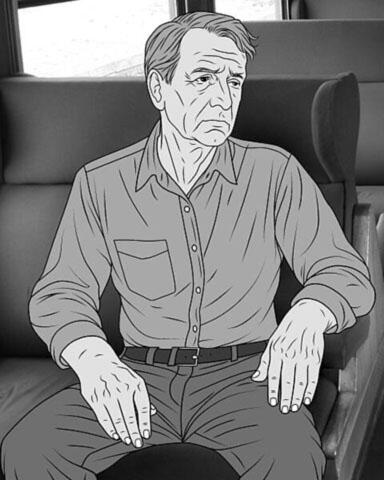
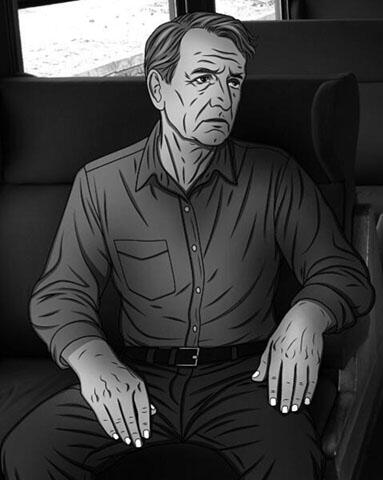
I've been involved in digital art and photomontage as a hobby for nearly two decades. My workflow generally involves sketching on paper, scanning, and processing the results into digital artwork. The examples above are my improvised artworks painted in Clip Studio Paint and Photoshop, making use of experimental methods.The examples below showcase my general workflow and a more refined approach to producing artwork with a consistent art style, and demonstrate my capabilities in digital painting without any reliance on AI image generators or tools. Additionally, I can always livestream or provide time-lapses as proof of human authorship.

Lineart
Coloring

Cel Shading
Lighting


Texturing & Refinement
Higher-quality source images and time-lapses can be found on my art pages. In these examples, I painted over real-life photographs sourced from Pixabay. For line art, I primarily rely on Clip Studio Paint's continuous curves without anti-aliasing. I work with layers and back up frequently. For visual editing, one of the tools I use is Nik Collection for Photoshop, which I find quite useful. In addition to creating my own textures, I occasionally incorporate royalty-free and public domain textures through masking and blending.When it comes to utilizing gen AI in art production, I am skeptical, as it can effectively undermine the collective efforts of the team. Regarding AI tools, I can name PicsArt's image quality enhancer and ClipDrop's light studio as practical tools that can be used in production while maintaining authorship clarity and PR safety.


Due to recent advancements in AI image generation, I no longer prioritize digital art. I still engage in art primarily as an editor, adjusting visual assets, correcting artifacts, maintaining stylistic consistency, and optimizing and managing assets.Besides digital art, I've been also involved in traditional tattoo art, which I pursued in response to the rise of generative AI, as it remains a relatively reliable creative field in the current state of technology. I use a tattoo machine and currently work with skin papers, and soon with live subjects. Below are my first two pieces, presented as physical, hand-drawn works alongside my digital art.

Halo of the Sun

Wendigo


The showcased examples are levels I created as scenes within the Unity environment utilizing the 2D Universal Renderer Pipeline. The sprites were sourced from public-domain and royalty-free photographs. I processed, adjusted, and made them transparent in Photoshop before placing them in 3D space, creating seamless 2.5D parallax maps designed around perspective projection rather than orthographic for better visual realism and immersion.I complement my levels by developing custom MonoBehaviours that manage post-processing FX and environmental conditions, such as day-night cycles and weather systems, utilizing Volume Profiles and adjusting properties like color grading in real time. Through these systems I also alter global shader parameters, such as wind direction and strength, as well as environmental lighting.I design and make use of particle effects, modify existing shaders and create new ones through Shader Graph, and integrate them into these systems to improve environmental coherence.In addition to these, I develop and integrate custom audio systems using AudioMixer parameters and Unity's audio FX components. For more information on these audio systems: Audio Engineering.
Environment module. For more info: Game Development & Design
In these examples, I make use of Sprites and Sprite Shapes using lit 2D URP shaders and sorting order instead of perspective ordering. While sorting adds extra complexity, it provides greater control over the environment and parallax pacing.Using SpriteRenderer in this way, rather than planar meshes with MeshRenderer, simplifies object management and level design. However, utilizing 2D URP lighting in 3D spaces and allowing angled perspective projection can present difficulties such as visual artifacts from certain viewpoints or when lights are not properly positioned, and this is the trade-off of the technique. Nevertheless, this pipeline I devised can yield visually unique and immersive environments when levels are built accordingly, which I ensure by designing levels in Play Mode and saving the changes.
Besides working on such environments, I also have experience with 3D environments. From a technical standpoint, I am familiar with reflection probes and I prefer to rely on baked lightmaps over real-time lighting and shadows to produce optimized levels. I work with cameras, employ camera volumes and post-processing FX, and optimize props and environments through the use of LODs and custom scripts managing GameObjects and Renderers.The examples below showcase a variation of my 2D level pipeline. It enables 3D URP lighting for SpriteRenderers through a custom lit shader with normals that can be affected by 3D lighting.


3D URP variation based on my 3D Lit Auto-Normal Sprite Shader
Music Production & Audio Engineering
Composition, Samples & Audio Systems
For composition and music production, I've been using FL Studio, which is my favorite digital audio workstation since the year 2010. I compose and produce music using a viola, MIDI keyboard, and the piano roll, while extensively making use of automation for parameters and VST plugins for virtual instruments and sound FX.I compose music across a wide variety of genres, including rock, neoclassical, avant-garde, medieval, metal, new age, and synth. Some of my tracks are available for preview in the Track Archive, a custom audio player I have designed for demonstration purposes.Over the course of my career, I've made uncredited contributions as a ghostwriter besides having released many singles and albums under my alias, Ms. Dysphoria. Some of my works are available on SoundCloud, Spotify, and Apple Music. For more details: Music.Below is a playlist on FL Studio for a track I composed, serving as a proof of provenance and human authorship. In my vault, I keep countless project files, backups, and MIDI sequences for my works.
In terms of audio engineering, I design and manage audio samples as well as develop audio systems within the Unity Environment.When designing samples, I make use of VST FX plugins and tools, such as Edison, Convolver, compressors, limiters, EQs, and reverbs. In addition to these, I have experience with controller plugins within FL Studio, including the Fruity Formula Controller.I record and create my own samples, or work with public domain and royalty-free recordings as source material, while recognizing such externally sourced recordings can cause complications with YouTube Content ID, Meta platforms and other detection systems, which is why I prefer not to rely on them in professional projects.
When managing assets, I use Audacity macros to batch-process large quantities of clips, handling normalization, fade curves, equalization, and format conversion optimized for Unity Engine. For large-scale organization, I use Bulk Rename Utility to manage naming conventions for audio clips, as well as my custom script which allows me to easily create as many AssetBundles as there are clips while using their filename as the AssetBundle ID.In my past experience, I worked on several MMO projects where I managed large quantities of audio samples and bundles, as well as developed interactive and optimized Unity-based audio systems.
When developing Unity-based audio systems, I make use of native audio FX components and AudioMixers. A typical system I build starts with creating AudioMixers for categories such as UI sound FX, in-game sound FX, music, and dialogue, and then assigning AudioSources to the appropriate mixers for channel management.I create a ScriptableObject containing arrays of AudioClips and store relevant sound effects together, such as footstep sounds depending on terrain or item pick-up sounds depending on type. This approach makes AudioClip management easier, keeps sound data organized, and allows randomization, which I find essential for creating immersive auditory experience. Pure randomness can produce unnatural repetition, for this reason I prefer pseudo-random selection: dynamically tracking recently played clips and avoiding them during playback to keep sound effects natural.I further improve this method by introducing randomization for pitch, volume, location, and filters such as High-Pass & Low-Pass. To keep variations sounding natural, I implement upper and lower values in order to cap randomization to reasonable levels.In the audio module, I also implement optional randomization for playback start times and duration alongside fade-in and fade-out through interpolation. As an example, audio would start playing from a random point and the volume would fade-in through a coroutine, last for a set or randomized duration, and fade-out. In this way, there would be greater variation for specific sounds.I add a coroutine for managing AudioSources and dispose of them. When optimization is a concern, I implement a pooling system. Additionally, I expose a variety of AudioMixer parameters and utilize them in several ways, such as shifting audio frequencies through interpolation depending on conditions. As an example, curbing high frequencies through Low-Pass for in-game music and sound FX AudioMixers during menu or other suitable screens.Below is an audio module I developed for my game project Sprout, adapted to HTML as an interactive web demo for demonstration.
This is the first audio system I developed with the aim of creating a system that would generate environmentally fitting and natural sounding interactive sound effects for immersion.Floors had types, optional script features, and tracked wetness value, which rain increased whereas clear weather gradually decreased for floors affected by weather conditions. Player speed was utilized for calculating the rate of occurrence for splash and wood creak sounds as well as for adjusting the audio frequency for the sound effects to introduce interactive auditory experience.This system utilizes randomization with pseudo-chance for clip selection to prevent repetition and produce natural sound effects.
This one is a Unity-based Android app I developed and partially adapted as an interactive web demo. It's an atmospheric pad making use of multiple audio sources, crossfade, and frequency shifts to generate sound, featuring some of the horror themed samples I created. It was an experiment on virtual instruments and will be available once I possess the necessary credentials to release on Apple Store and Google Play. For more info: Mobile.These are some of my interactive audio systems I worked on solo and there are several others I developed, mainly for MMO projects. In the end, audio is my specialty and this concludes the section.
Interface Development & Design
Graphical UI & Procedural Generation
Animation & Video Editing
Puppets, Filmmaking & Unity Engine
The examples above are UI created within the Unity environment. I designed the layout and elements, developed the back-end and the front-end, animated through coroutines, and created the background levels from scratch, based on 2D and 3D URP.When I design interfaces, I make sure they support a wide variety of popular aspect ratios through proper use of anchors and Unity's interface components. I have years long experience in developing procedurally generated interfaces for character and world editors. I make use of layout group components and develop Prefab-based instantiation systems to populate the interface for editors.Below is an editor I developed and designed for an MMO project. More information and technical details are available here.
For animation and video editing, I use After Effects, Filmora and FFMpeg. I am familiar with 2D rigging, puppet animation, sprite sheets and Unity's animation system. I do not possess in-depth experience in creating 2D or 3D animation. I have relatively more experience in video editing, as I frequently do social media content creation, as well as in editing, integrating, or working with 2D and 3D animation within the Unity environment.Above is my most recent animation, Wendy the Wendigo, which I created from scratch in a 5 hour long speedrun on bringing a creation to life. I used a sketch I'd drawn on a skin paper for a tattoo, created line-art, painted, animated, voice-acted, edited into a video and prepared a time-lapse as proof of provenance.When it comes to Unity Engine's animation system, I am familiar with triggers and bools, designing animation clips, crossfading and blending, targeting bones, animation weight and states, and adjusting inverse kinematics for dynamic animations.As extra details, I make use of several After Effects plugins, such as Saber and AEJuice. Outside the Unity environment and content creation, I also work on animated banners, profile pictures, and ads. I'm familiar with animated visual formats such as GIF, WebM, WebP, and APNG, while knowing where to deploy them effectively.
3D Character Design
Texturing, Shaders & Customization
3D Hairstyling
Design, Optimization & Customization


When it comes to texturing, my specialty is skin and facial details, such as eyebrows, eyelashes, beard, makeup, tattoos, scars, and skin imperfections. I've designed and managed numerous textures and maps for character customization in live MMO games.Depending on the asset, I either hand-paint textures in Photoshop 3D Workspace and Blender, or work from real-life photographs by morphing them, extracting details, refining, and reworking them into game-ready textures for character models.I have worked with character customization shaders for the face and body, including the eyes, eyelashes, and hair. The examples above show my base textures, blendshapes, ported hairstyles, and modified PS2.0 shader with auto-normals on the same head mesh. When character shaders support multiple layers for in-game user customization, I prepare maps for them separately and according to the requirements of each layer, as exemplified below.


There is no limit to customization except for the limits of shaders and GPU
In addition to creating maps for customization shaders, I have also worked directly on such shaders, adjusting shader methods, UV layer placements, and calculations to a degree. Back in the day, I was working with Pixel Shader 2.0, which had constant-register limitations and allowed at most 32 variables to be controlled at runtime. I would pack multiple controls into float4 values in order to bypass that limitation and increase options for customization.As a practical production example, I designed eyebrows and beard in grayscale and on a black background, and used the same source both as a texture and as a heightmap, automatically converting the heightmap into a normal map at runtime through a shader I modified for this purpose. This effectively removed the need to create separate normal maps manually, automatically generated normal maps for hundreds of already available options, improved the visual quality, and made the workflow more time-efficient.In MMO environments, I handled the management of 2D assets, most of which contained textures and maps for customization. There were thousands of AssetBundles, which led me to develop workflows in order to effectively manage such large quantities, frequently utilizing AssetStudioGUI to inspect bundles, macros in Photoshop in order to batch-process textures, Bulk Rename Utility to manage naming conventions for texture files, and my custom Unity Editor script to automatically name AssetBundle IDs based on their filenames before bundling them for integration.Regarding blendshapes, I have experience in creating them for body and face, as well as separate morphs for individual parts such as the nose, lips, and jaw. When I design blendshapes, I take care with additional meshes such as eyes, mouth, and eyelashes through masking, in order to prevent clipping and visual artifacts. When supported, I prepare blendshapes for them separately and in a way that they can perform seamlessly with the mesh for head, by maintaining the same blendshape order and setting their blend weight together through the SkinnedMeshRenderer API.The examples are blendshapes I designed for face customization under the constraints imposed by such additional facial meshes.
Hairstyling is my expertise in 3D modeling. I've created and ported countless customizable hairstyles for MMO games, mainly weight-painted and low-poly with trigons ranging from 5,000 to 10,000, suitable for the performance needs of MMO environments.I build hairstyles either from my own hair cards or by adapting provided meshes to character models, optimizing polygon density while maintaining fine topology suitable for animation. I fix visual artifacts such as hair clipping, adjust UV maps and vertex groups for cards, prepare textures for hair including scalp, transfer and refine weight paint to ensure smooth deformation for animations, and design tri-color gradient maps for hair color customization.I additionally create blendshapes to introduce compatibility with head accessories, as well as blendshapes for user customization. When I create LOD for optimization needs, I make sure to preserve the keys through decimation to keep it artifact-free from distance.


Elastic Deform & Pose are my favorite tools on Blender
In my workflow, when I prepare scalp textures, I either use them as a texture for the head mesh when supported by the shaders, or prepare a separate scalp mesh and integrate it into the hairstyle.Besides weight-painted hair, I have also worked with hair physics: I can groom Alembic hairstyles, integrate them into the Unity environment, develop supporting systems (e.g weather/wind), and tweak simulation settings for stable visuals and performance. I've primarily worked with Unity's com.unity.demoteam.hair package.As a technical example, when optimizing or weight-painting hair, short hairstyles affected only by the head vertex group can be decimated aggressively and weight-painted fully in red, whereas long hairstyles affected by several vertex groups (e.g., breasts, chest and clavicles) require a more delicate approach in polygon optimization and weight-painting. In those cases, decimating the static head part and carefully reducing or even increasing the polygon count for those affected areas is required to ensure smooth deformation during character animations. Intersections affected by multiple vertex groups, such as the middle parts of the chest and back, need to be painted carefully in order to prevent clipping between hair strands in the area.As another technical example, when preparing color maps, I use black-red-yellow as well as black-green transitions, substituting green for yellow when the mask needs to transition directly from black. Black-to-yellow gradients can be unreliable as they raise multiple color channels together, which can cause unwanted blending depending on how the shader interprets the mask. In the example below, I separated the UV map for specific hair strands and assigned them a separate UV area for different coloring.This method, which I developed after discovering the black-to-yellow transition problem long ago, proved effective at the time, allowing greater variations in hair color customization than using a single black-red-yellow gradient map across the entire hairstyle. It is useful when needing to work with a single element, otherwise a more practical approach would be creating and assigning hair strands different elements in Blender and separate color maps.

3D Wearables
Preparation & Integration
3D Prop Design
Hard Surface Modelling


In this context, I use the term wearable to refer to any equippable item, including clothing and accessories. My expertise is primarily focused on modifying, preparing, optimizing, and integrating wearables as customizable assets rather than creating meshes. The examples displayed aren't my original works, but meshes that I was tasked with preparing and integrating into an MMO project.My workflow involves adapting meshes to fit character models while preserving clean topology, painting item masks to hide body parts to prevent clipping, preparing UV layouts for additional maps, creating color maps or separate material elements for in-game color customization, and refining weight painting according to the requirements of each wearable. For instance, dresses and skirts require a more delicate approach as they are influenced by multiple active vertex groups, including the lower torso and both thighs. These areas need to be weight painted carefully to ensure proper deformation without clipping during character animation.Proper weight painting is also important for clean deformation when wearables are affected by body customization based on bone scaling. When the body mesh utilizes blendshapes for body customization, I generate corresponding morphs for wearables through nearest-surface projection and barycentric interpolation for compatibility, followed by manual refinement where required.To expand wearable customization, I create overlays and prints, as well as blendshapes for form adjustments such as skirt length and visor curvature. I work with custom clothing shaders supporting additional maps and adjustable parameters (e.g. print placement, adjustable plaid overlays) to provide more customization features. When appropriate, I complement my assets with particle FX, base animations (e.g. wingbeats), physics, and secondary motion using plugins such as Dynamic Bone for wearables like tails and capes.When optimizing assets, I aggressively decimate static wearables (e.g. hats and spectacles), static regions (e.g. hood part of hoodies), and rigid surfaces (e.g. metal), while carefully reducing geometry and adding supporting polygons for soft materials in actively deforming areas such as joints. This region-specific optimization improves performance while preventing visual artifacts during animations caused by improper topology or insufficient geometry.I finalize wearables by preparing LODs, playtesting them to ensure proper quality and performance, designing interface icons when needed, and integrating the finished assets into the Unity project.
Besides hairstyles, I also design 3D props. I use reference images and recreate them as meshes, and at times I improvise blueprints and create my own designs. The examples showcased here in this section are my improvised works without relying on a reference.My workflow prioritizes speed, aiming for artifact-free results with clean maps and normals, without spending unnecessary time spent on fine topology for static meshes not requiring morphing.


Software
Development & Design
| Info |
|---|
| As a software developer, I have commonly worked on Windows applications and utility tools. My work is generally centered around improving workflows, reducing manual labor, and bridging functionality between otherwise disconnected systems. |
| In terms of languages, C# is my primary and preferred programming language. I have additionally worked with PowerShell, HTML / CSS, and I am comfortable working with any language syntactically similar to C#, such as JavaScript and TypeScript. |
| When it comes to interface design, I mostly rely on Visual Studio Blend alongside Windows Presentation Foundation (WPF). |
| In terms of APIs & libraries, my specialty is Unity and I've been working with that since 2020. I believe it is unnecessary to list libraries, as I consider the ability to work with any well-documented API a fundamental skill in software development. |
| Below are some of my original applications and utility tools built on C# and WPF. |
Integrity Verifier
ㅤBulk Replacer ⚠

Extracts file records from a root directory and compares them with another directory to detect missing, excess, or mismatched files. Useful for spotting differences and creating quick patches through the copy feature to keep files synchronized across clients.

Functions similarly to Notepad’s Find & Replace, but operates on file names and file contents across a selected directory, while offering optional inclusion of subdirectories and case sensitivity. It requires caution as misuse can result in irreparable file damage.
Backup Automator
ㅤFile Shredder ⚠

Backs up specified files or folders at set intervals, while offering optional inclusion of subfolders and compression to reduce file size. This tool is particularly useful for databases and projects, as well as games and game servers that lack native support for backup or multiple save files, such as Minecraft and 7 Days to Die.

Attempts secure deletion to reduce recoverability. While not guaranteed on all file systems, this tool is useful for bulk deletion of files via naming convention or content-based imprint with key codes in emergency. (e.g. delete every file with the string [113] in it) It requires caution as misuse can result in irreparable file damage.
Cryptic Transmitter
Advanced Rich Presence

A basic open-source, real-time, peer-to-peer chat application with end-to-end encryption. It was developed as an experimentation. The tool opens a port to establish a connection and transmits direct messages without needing a third party. It is designed with people wanting full control and transparency in mind. Either VPN or IPv6 is suggested due to the restrictions of CGNAT, if present.

A custom Rich Presence tool for Discord. It supports animated buttons, text, and images. Presence can be designed through the use of available prompts without requiring any coding experience.
Automated Whitelister
Anti-Whitelister

A server-side application that listens on a designated server port and receives encrypted client authentication requests. It verifies request authenticity and, if valid, adds the client's IP address to the firewall whitelist. Repeated invalid authentication requests are ignored, rate-limited, or blacklisted for temporarily, helping protect critical ports on the server. This system can be integrated into launchers or games by invoking a method prior to connecting to the server, ensuring that only authenticated clients gain access.I do not consider myself a cybersecurity engineer; this was a makeshift solution I developed long ago while dealing with DDoS service disruptions as an administrator. It proved effective and helped maintain server stability against common attack patterns.

A tool that mimics whitelist requests to Automated Whitelister, using proxy to establish TCP connection and imitate authenticity. This results in specific ports being opened for the proxies on the server, enabling a denial-of-service scenario. The tool relies on reverse engineering to replicate the authentication method and makes use of a proxy list, which can be imported before initiation. It is an experiment on how I can exploit my own security systems.
Discord
Development & Design
| Info |
|---|
| When it comes to Discord, I possess experience in structuring and designing the backend and frontend for servers. I find having a reliable and presentable community server for presence on such platforms useful and valuable in the industry. |
| I design layouts, animated icons, banners, stickers, emojis, embeds, make use of Markdown, and incorporate different Unicode characters to improve server presentability while also handling the backend and bots to ensure server safety. |
| I develop third-party plugins and custom bots using C# and WPF. I have experience in creating interactive Discord Rich Presence and integrating it into games and software, including those without native support for the Discord Social SDK. |
| In addition to these, I am a former BetterDiscord plugin developer and released plugins for the platform in the past. |
Rich Presence
Plugins
My works, Discord-Unity Integration and Advanced Rich Presence. The latter enables users to design custom Discord Rich Presence profiles using only prompts without requiring coding involvement. I can create dynamic and animated Rich Presence integrations for games, applications, and even individual user instances within the operating system. For unsupported or outdated game frameworks, I implement Rich Presence through external applications utilizing interprocess communication (IPC) and ports for presence updates.


A BetterDiscord plugin (currently outdated - no longer in service). It customizes letters, numbers, symbols, and even space width, essentially functioning as a character converter. DiscordFont was my first attempt at developing a plugin for a software and my first time with JavaScript, a language I knew little about aside from its similarity to C#. It can work on older versions of BetterDiscord.
Bots
Webhooks

A Discord bot I developed with WPF/C#. It can send messages in servers, display and handle direct messages, join voice channels, convert text to speech through the Balabolka voice synthesizer, and stream audio files using FFmpeg. When provided with a valid ChatGPT API key, it can respond to user messages within servers.

I make use of webhooks to transfer information from applications. The example shows an in-game security system that detects and reports user activity, such as messages containing profanity or the presence of blacklisted or suspicious processes, by sending an embed to a designated Discord channel and tagging moderators.
Group Design
Embeds


I design servers through the use of emojis, Unicode symbols, formatting consistency and navigation across channels and roles. I create visual assets such as banners, animated icons, and role indicators to enhance overall presentation for game projects. In addition, I structure server content using Discord Markdown and code blocks to produce clear and appealing updates & changelogs.


I design embeds in various formats to deliver announcements, information, and reports in organized and visually appealing ways while being fully aware of cross-platform differences (e.g. phones displaying embeds differently) and optimizing for the best result. For my embeds, I also make use of custom emojis, code blocks, as well as users, roles, and channels through the use of their IDs.
Literature
| Info |
|---|
| This section presents my works and information on my background. |
The Author
| Background |
|---|
| [Redacted] |
Works